


Construction Equipment Dealer Transport
Nationwide equipment transport for dealer inventory transfers, customer deliveries, branch relocations, trade-ins, attachments, and coordinated multi-machine moves.
Request an Equipment Dealer Quote
Get Your Transport Quote
Choose what you’re transporting and we’ll ask only for the details we need.
(800) 251-9024Quote request received.
Our transport team will review the details and contact you shortly.
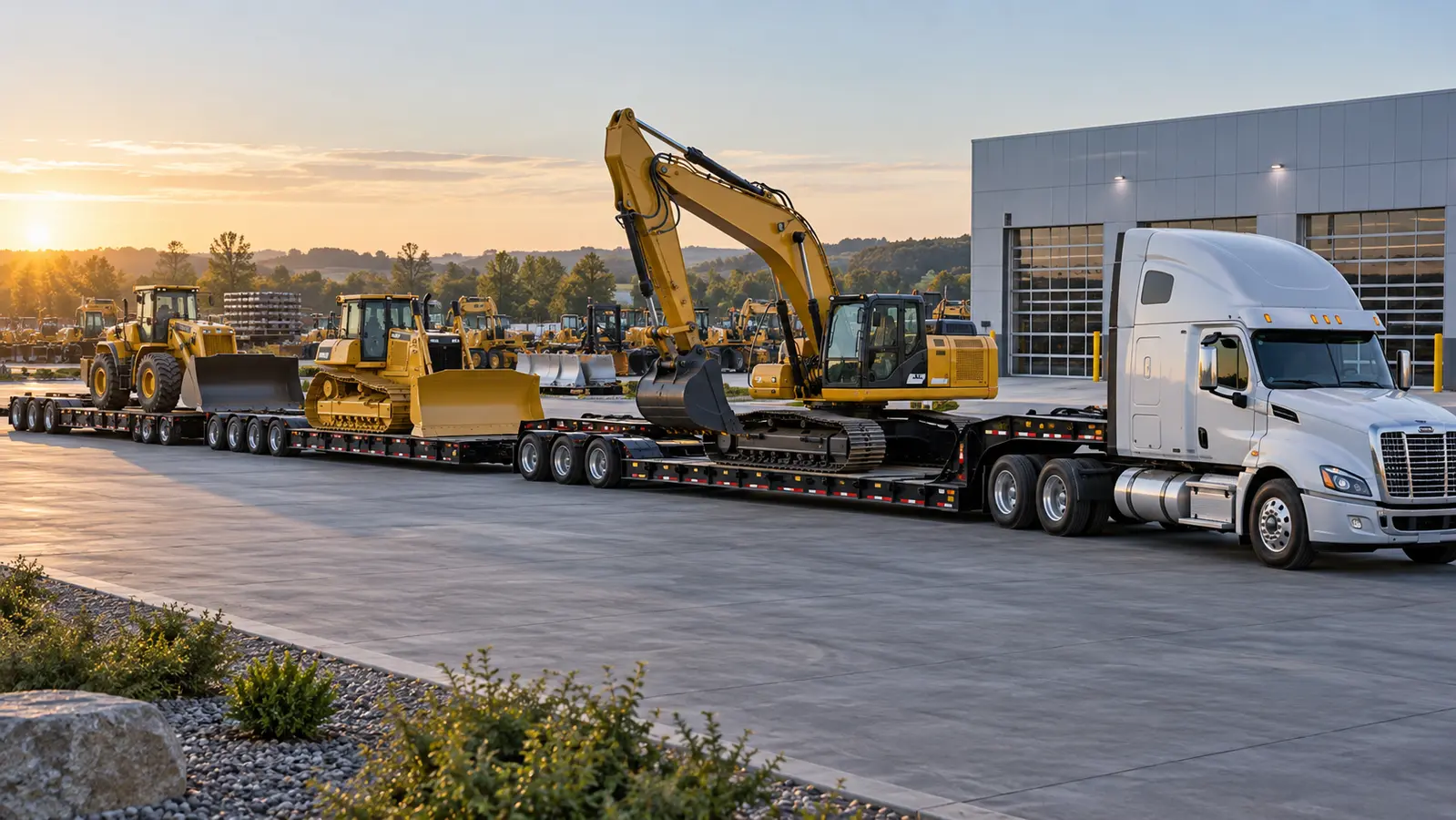
Call (800) 251-9024Construction equipment dealer transport works best when every machine is treated as a documented inventory unit and the shipment is planned around verified dimensions, attachments, release status, and destination access. A complete equipment manifest allows excavators, bulldozers, wheel loaders, compact machines, and attachments to be matched with the appropriate trailer before a truck reaches the dealership.
Elevation Transport Services coordinates nationwide construction equipment transport for equipment dealers, distributors, manufacturers, rental operations, contractors, and commercial buyers. This guide focuses specifically on dealer inventory transfers, customer deliveries, branch relocations, trade-in moves, and mixed-machine shipments.
Why Dealer Equipment Transport Requires Inventory-Level Planning
A dealer move is not simply an excavator shipment or a loader shipment. It is often connected to a sale, an incoming trade, a branch transfer, a customer delivery, a demo return, or an inventory-balancing decision. The transportation plan has to support that business event without confusing stock numbers, accessories, release documents, or delivery instructions.
Dealer transport becomes more complex when several machines share one deadline but differ in size, configuration, operating condition, or destination. A compact loader and a large excavator may leave the same yard, yet require different loading methods and trailers. A sold machine may be ready immediately while a trade-in is still waiting for inspection or paperwork. Separating ready units from exception units keeps one unresolved machine from delaying the entire group.
Build a Dealer Equipment Manifest Before Requesting Trucks
The equipment manifest is the foundation of an accurate commercial quote. Each row should identify one machine and everything that must travel with it. Manufacturer brochures are useful references, but transportation must be planned from the machine’s actual configuration at pickup.
Recommended information for every machine
- Dealer stock number, serial number, PIN, or other unique identifier
- Year, manufacturer, model, and machine type
- Actual overall length, width, height, and operating or transport weight
- Installed bucket, blade, ripper, counterweight, cab guard, tires, tracks, or other configuration details
- List of loose attachments and the dimensions and weight of each item
- Whether the machine starts, moves, steers, and brakes as designed
- Known leaks, damaged components, warning conditions, or loading restrictions
- Pickup address, contact, gate hours, appointment requirements, and release status
- Delivery address, receiving contact, site hours, and unloading capability
- Clear photographs from all sides, including attachments and the highest and widest points
A spreadsheet is especially useful for multi-machine moves. It gives the dealer, transport coordinator, driver, and receiving customer one shared unit list and reduces the chance of the wrong machine or attachment being released.
Confirm the Dealer Release Packet
Transportation should not be dispatched until the release process is clear. The pickup contact should confirm that payment or internal transfer requirements are complete, the correct unit is accessible, keys are available, gate or appointment instructions are documented, and the collecting carrier can be identified to the yard.
A practical release packet may include:
- Stock number and serial number for each machine
- Customer or branch destination
- Authorized pickup contact and release reference
- Attachment list and photographs
- Operating instructions for battery disconnects, hydraulic locks, parking brakes, or machine-specific controls
- Known condition notes and loading limitations
- Dealer documents that must travel separately from the equipment
Documents containing ownership, financing, or customer information should be handled according to the dealer’s own procedures. They should not be left loose inside an open cab or storage compartment.
Trailer Planning for Excavators, Dozers, and Loaders
Trailer selection depends on the complete loaded profile, not the machine name alone. The transport coordinator evaluates the machine and trailer together because deck height, usable deck length, axle capacity, loading angle, and route restrictions all affect the final plan. For a general equipment comparison, see the heavy equipment and oversize transport service.
Excavator transport
Excavators require confirmation of track width, house and counterweight dimensions, boom and arm position, bucket configuration, and any additional attachments. A removable-gooseneck or lowboy trailer may be considered when ground-level loading and a low deck are important. The machine should be quoted in its intended transport configuration, including the bucket or attachment position. Our excavator transport page explains the broader machine-specific planning process.
Bulldozer transport
A dozer’s blade, track width, cab or canopy height, and rear ripper can materially affect width, length, and weight distribution. The dealer should state whether the blade or ripper will remain installed and whether any removed components require a separate trailer position. See the dedicated bulldozer transport service for additional preparation considerations.
Wheel loader transport
Wheel loaders need accurate tire-to-tire width, cab height, articulation position, bucket dimensions, and operating weight. The bucket should be included in the measurements even if it will be detached, because the detached bucket still needs secure deck space. Review the wheel loader transport page for machine-specific quote requirements.
Compact and mixed dealer inventory
Compact track loaders, skid steers, mini excavators, backhoes, telehandlers, and attachments may sometimes be grouped efficiently, but only after deck space, combined weight, loading sequence, and securement access are evaluated. A load that fits by length may still be unsuitable because the weight is concentrated incorrectly or the driver cannot access the required securement points.
Dedicated Trailer or Coordinated Multi-Machine Move?
A dedicated trailer is often appropriate for a large machine, a time-sensitive customer delivery, or equipment that occupies most of the usable deck. Multiple compatible units may be coordinated together when their dimensions, weights, route, release timing, loading sequence, and destination access align.
The decision should be based on operational fit rather than unit count alone. Two machines can be harder to combine than four smaller units if their weights are concentrated poorly or their attachments block safe securement access. Conversely, several compact machines moving between the same two dealer branches may form an efficient planned load.
For several machines, Elevation Transport Services can organize the project by trailer group, origin, destination, readiness, and pickup wave. This gives the dealer one commercial transportation plan while keeping each machine identifiable by stock or serial number.
Planning Multi-Origin and Multi-Destination Dealer Moves
Inventory transfers do not always begin and end at one facility. A dealer group may move equipment from several branches into one regional location, deliver sold units to separate customers, or exchange inventory between territories.
Before routing is finalized, identify:
- Which units are ready at each branch
- Whether all locations use the same release process
- Gate hours and appointment requirements at every stop
- Truck and trailer turning space at each facility
- Whether a stop can safely load or unload the assigned trailer type
- Which units have fixed customer delivery dates
- Whether attachments must remain paired with a specific machine
Routing should not assume that every stop can accommodate a lowboy or RGN simply because construction equipment is stored there. A temporary sales lot, urban branch, customer yard, or active job site may have narrower access than the dealer’s primary facility.
Dealer Yard and Customer-Site Access
The loading and unloading areas should be firm, level, and clear of parked inventory, overhead obstructions, soft shoulders, and tight turns. The site contact should confirm that the assigned tractor and trailer can enter, align, load, and exit without relying on an unsafe maneuver.
At delivery, the receiving party should know which machine is arriving, have an authorized contact available, and provide adequate space for unloading. If the machine cannot unload under its own power, the required assistance must be arranged before the carrier arrives. Transportation equipment should not be expected to substitute for an undisclosed crane, wrecker, forklift, or repair service.
Non-Running Machines, Trade-Ins, and Condition Exceptions
“Non-running” does not describe the complete loading condition. A disabled machine may roll and steer, have locked tracks or wheels, lack hydraulic pressure, have a dead battery, leak fluids, or sit in a position that prevents direct trailer access. Each condition calls for a different loading plan.
For a non-running or recently traded machine, provide photographs and answer these questions:
- Can it be placed in neutral or have the drivetrain released?
- Do the tracks or wheels move freely?
- Can it steer, articulate, and brake?
- Are the tires inflated and tracks intact?
- Can the bucket, blade, boom, or attachment be positioned for transport?
- Is shop equipment or another suitable machine available to assist safely?
- Is there direct, level access for the assigned trailer?
Early disclosure protects the dealer’s schedule. Discovering a locked machine or inaccessible attachment after the truck arrives can change the required equipment and create avoidable delays.
Manufacturer Reference Pages for Dealer Inventory
Dealer inventories often include several brands and machine classes. Elevation Transport Services maintains manufacturer-specific planning pages for Caterpillar equipment transport, John Deere equipment transport, Komatsu equipment transport, Volvo construction equipment transport, and CASE construction equipment transport.
Additional references cover Bobcat, Kubota, JCB, New Holland, Takeuchi, and Yanmar. Manufacturer names are used descriptively; Elevation Transport Services does not imply affiliation or dealership status.
What Determines a Construction Equipment Dealer Transport Quote?
A dealer quote is based on the actual machines and movement plan. Important factors include machine dimensions and weight, installed and loose attachments, operating condition, trailer type, origin and destination, route, loaded width and height, permits when required, carrier positioning, site access, unit count, and scheduling flexibility.
Multi-machine volume can create planning efficiencies when equipment is ready together and the routes align, but it does not guarantee a fixed per-unit discount. A mixed group with several destinations, non-running units, incomplete measurements, or narrow appointments may require separate equipment and pickup windows.
Construction Equipment Dealer Transport FAQs
Can several types of construction equipment move under one dealer project?
Yes. Excavators, dozers, loaders, compact equipment, and attachments can be organized under one project plan. Each unit still needs its own dimensions, weight, condition, release information, and equipment assignment.
Should a dealer use brochure specifications for the quote?
Brochure specifications can help identify the base model, but the quote should use the actual machine configuration. Buckets, blades, rippers, guards, tires, tracks, counterweights, and other options can change the transport profile.
Can attachments travel with the machine?
Often they can, provided the trailer has sufficient deck space and capacity and the attachment can be secured appropriately. Every attachment should be listed, measured, photographed, and paired with its machine before dispatch.
Can Elevation coordinate delivery directly to a customer or job site?
Yes, when the site can safely receive the assigned equipment and the delivery requirements are disclosed in advance. The customer should provide the receiving contact, access instructions, unloading conditions, and any appointment restrictions.
Request a Nationwide Dealer Equipment Transport Quote
Send one row per machine with the stock or serial number, year, manufacturer, model, dimensions, weight, attachments, operating condition, pickup location, destination, timing, and photographs. For several units, identify which machines are released now and which are still waiting for paperwork, preparation, or customer approval.
Request a construction equipment dealer transport quote from Elevation Transport Services. We coordinate nationwide transportation for equipment dealers, manufacturers, rental companies, contractors, and commercial buyers based on the verified requirements of each machine, attachment, route, and site.
Coordinate a Dealer Equipment Move
Dealer Shipping Checklist
Use our construction equipment dealer shipping checklist to prepare the manifest, dimensions, attachments, release and loading details.