Bulldozer transport cost depends on much more than mileage. A quote must account for the dozer’s actual weight, blade width, overall height, track width, rear attachment, operating condition, loading access, trailer configuration, and route. Two machines from the same product family can require different trailers and permit plans when one has a wider blade, a ripper, added guarding, or site-specific modifications.
For many small and medium crawler dozers, an RGN or lowboy is the practical starting point. Some compact machines may fit a step deck or flatbed when the loaded height, weight, ramps, and securement plan work. Larger mining dozers and unusually wide configurations can move into multi-axle or superload territory, but this guide focuses on profitable, operationally manageable shipments that can usually be planned with commonly available specialized trailers and ordinary shipment-specific permit review.
In this guide:
What Is Needed for an Accurate Bulldozer Transport Quote?
A useful quote describes the machine exactly as it will be presented at pickup. A model number or auction listing is a helpful starting point, but it does not replace verified shipment information. Dozers may have several blade, track, cab, guarding, undercarriage, drawbar, winch, and ripper configurations.
Provide the following:
- Manufacturer, model, serial number when available, and approximate year
- Verified operating weight, including the installed blade, ripper, winch, guarding, and other attachments
- Overall length, width, and height in transport-ready condition
- Blade type and exact blade width at its widest point
- Track width, outside-to-outside track measurement, and undercarriage condition
- Rear attachment details, including ripper shanks, drawbar, winch, counterweight, or towing equipment
- Whether the machine starts, steers, travels in both directions, and has dependable braking and hydraulic functions
- Ground clearance and any damaged, loose, or leaking components
- Pickup and delivery addresses, site contacts, operating hours, and appointment requirements
- Surface conditions, turning space, overhead clearance, and access for a tractor-trailer
- Current photographs from all sides, plus close views of the blade, tracks, rear attachment, and cab roof
If the dozer is at an auction, dealer, mine, quarry, forestry site, or active construction project, confirm who can operate it and whether the facility provides loading assistance. A quoted plan can change when the machine cannot travel under its own power or when the trailer cannot safely reach the advertised loading area.
The Main Bulldozer Transport Cost Factors
Machine weight and axle distribution
The dozer’s complete transport weight determines trailer capacity and helps establish the tractor, axle count, and weight distribution needed for the route. The bare tractor weight shown in a specification sheet may exclude the installed blade, ripper, winch, guarding, or other equipment. An inaccurate weight can result in the wrong trailer arriving or require a revised permit and axle plan.
Blade and track width
Blade width is often the dimension that controls whether a crawler dozer remains within ordinary legal width or needs an oversize permit. Angled, straight, universal, semi-universal, and six-way blades create different profiles. Track width also matters, especially on low ground pressure configurations. Both dimensions should be measured rather than estimated from a sales listing.
Loaded height
The highest point on the machine plus the selected trailer’s deck height determines loaded height. Cab roofs, ROPS or FOPS structures, exhaust stacks, air intakes, GPS masts, lights, and guarding may be the highest point. A lower RGN or lowboy deck can reduce route complexity, but it does not eliminate the need to verify the complete combination.
Distance, route, and carrier positioning
Loaded mileage is only one part of the price. Carrier availability near pickup, deadhead distance, fuel, tolls, terrain, state lines, restricted routes, seasonal road conditions, and the availability of a practical return load all affect the quote. A short move can still carry meaningful fixed costs for equipment positioning, loading time, permits, and site coordination.
Running condition and loading method
An operable dozer may be able to crawl onto a detached RGN deck under controlled conditions. A non-running machine may need a properly rated winch, recovery equipment, crane, or other qualified loading support. Frozen tracks, hydraulic problems, disabled steering, missing batteries, or damaged undercarriage components can materially change the equipment and labor required.
Permits and route restrictions
Oversize or overweight permits, allowed travel windows, axle restrictions, bridge limits, and any required pilot vehicles add time and cost. These items must be determined from the actual loaded configuration and route. They should never be assumed from the dozer model alone.
For a broader explanation, see our heavy equipment transport cost guide.
Dozer Measurements That Change the Transport Plan
Measure the machine in its travel position
Place the dozer on reasonably level ground and measure the complete machine in the approved transport position. Record the front of the blade to the farthest rear attachment, the widest blade or track point, and the ground-to-highest-point height. Include bolt-on extensions, rock guards, sweeps, screens, lights, antennas, and jobsite additions.
Blade position and removal
Do not assume the blade can simply be angled, folded, or removed to avoid a permit. Blade movement may reduce one dimension while increasing another, and hydraulic or mechanical limits may control the approved travel position. Removal can require qualified labor, lifting equipment, safe blocking, capped hydraulic connections, separate securement, and additional deck space.
If blade removal is being considered, confirm the procedure with the equipment owner, manufacturer guidance, and a qualified technician. The detached blade becomes a separate cargo item with its own verified dimensions, weight, lifting points, and securement plan. The total project cost may be higher even if the tractor body becomes narrower.
Rear ripper and attachments
Ripper frames and shanks add length, weight, and ground-clearance concerns. Confirm whether the shanks can be raised and locked in the approved travel position. A winch, counterweight, drawbar, or towing package may also affect deck placement and rear overhang.
Track and undercarriage condition
Steel tracks need a suitable loading surface and securement plan. Mud, rock, ice, or demolition debris packed into the undercarriage can add weight and create road hazards. Excessive track wear, a thrown track, seized components, or damaged rollers may prevent normal loading even when the engine runs.
Choosing an RGN, Lowboy, Step Deck, or Flatbed
The correct trailer must satisfy rated capacity, usable deck dimensions, axle distribution, loaded height, loading method, and route requirements. Our RGN, lowboy, and step-deck trailer guide explains the basic differences.
RGN or removable-gooseneck trailer
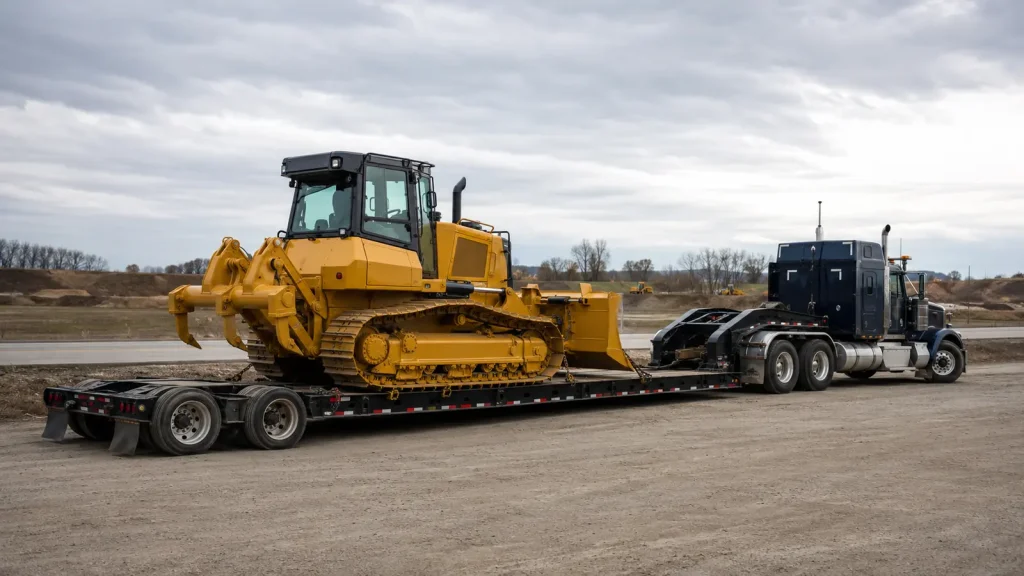
An RGN is a common choice for crawler dozers because the front deck can be detached to create a low loading ramp. A functional machine can often crawl onto the deck without separate loading ramps. The loading area must still be firm, level, and large enough for the tractor and trailer to align safely.
RGNs are available with different deck lengths, axle configurations, and capacities. The dozer’s weight and placement must match the specific trailer rather than a generic RGN label.
Lowboy trailer
A lowboy provides a low deck that helps manage cab and guarding height. Some lowboys load from the rear with ramps, while detachable configurations load from the front. The loading method, ramp capacity, breakover angle, traction, and ground clearance must suit the machine.
Step-deck or flatbed trailer
Compact dozers may fit a step deck or flatbed when weight, loaded height, deck width, ramps, and securement requirements are compatible. The higher deck can make an otherwise manageable machine overheight. Confirm the complete loaded profile before choosing the less specialized trailer solely to reduce cost.
Double-drop or multi-axle equipment
A double-drop or additional axle configuration may be appropriate when deck height, concentrated weight, or route requirements call for it. Exceptionally large mining dozers may need more complex equipment, blade disassembly, escorts, route surveys, or superload planning. Those extreme projects are outside the core focus of this guide and require a separate engineering and permit review.
Loading and Securement for Crawler Dozers
Prepare the loading area
Verify firm ground, adequate turning space, overhead clearance, trailer alignment, and a clear path before the carrier arrives. Soft shoulders, steep grades, mud, narrow gates, low branches, overhead utilities, and crowded auction yards can prevent safe loading. Do not position the trailer where loading could block traffic or active jobsite operations without an approved site plan.
Confirm who will operate or recover the machine
The customer, facility, carrier, and any loading contractor should understand their roles before pickup. A qualified operator should follow the machine and trailer loading procedures. Non-running recovery requires equipment rated for the dozer’s weight and condition. The carrier should not discover at pickup that a disabled machine needs services that were not included in the quote.
Use a machine-specific securement plan
49 CFR 393.130 contains federal securement requirements for heavy vehicles, equipment, and machinery weighing 10,000 pounds or more. The carrier’s actual securement plan must account for the machine, trailer, approved attachment points, and applicable rules.
Chains and binders should use suitable structural points without damaging hydraulic lines, steps, sheet metal, or components that are not designed for securement. The blade, ripper, and other accessories must be restrained as required. Dirt and debris should be removed from the tracks and deck, and the carrier should recheck the load during transit as required.
Do Bulldozers Require Oversize or Overweight Permits?
Some dozer moves remain within legal dimensions and weights, while others require ordinary oversize or overweight permits. The blade is frequently wider than the trailer, and the combined tractor, trailer, cargo, and axle weights can create requirements even when the machine itself does not appear unusually large.
The FHWA oversize and overweight permit overview explains that states administer their own permit processes. Requirements can vary by jurisdiction, route, axle configuration, travel time, and loaded dimensions. A permit in one state does not establish the rules for another.
Pilot cars are not automatically required for every permitted dozer. Escort thresholds and permit conditions depend on the loaded width, height, length, weight, route, and state. Bridge engineering, extensive route surveys, and police escorts are generally associated with more complex configurations and should not be represented as routine for standard dozer moves.
Review our oversize load route-planning checklist for the information used during shipment-specific planning.
How to Control Avoidable Dozer Shipping Costs
- Send verified measurements and weight before dispatch. This helps match the trailer and reduces last-minute equipment or permit changes.
- Disclose the installed blade and rear attachments. Do not quote the bare tractor when the machine will ship fully equipped.
- Provide current photographs. Images can reveal guarding, extensions, access conditions, and modifications missing from a specification sheet.
- Confirm operating condition honestly. A machine that starts but cannot steer, brake, or travel reliably is not transport-ready.
- Prepare both sites. Clear access, confirm appointments, and identify the operator or loading contractor before the carrier arrives.
- Compare blade-on and blade-off plans only when removal is practical. Include labor, lifting, separate cargo space, and reassembly in the comparison.
- Allow a reasonable planning window. Trailer positioning, permits, and facility appointments may be more efficient when the move is not treated as an emergency.
- Coordinate multiple units as a project. Dealers, auctions, contractors, and fleet owners may reduce duplicated site work when several compatible machines move under a planned sequence.
Elevation Transport Services coordinates heavy equipment transport and specialized transport and construction equipment transport for contractors, dealers, auctions, rental fleets, mines, quarries, forestry operations, and equipment owners. Related planning resources include our wheel loader transport service and excavator transport guide.
Bulldozer Transport Cost FAQs
How much does it cost to ship a dozer?
There is no responsible universal price. The quote depends on the dozer’s verified weight and dimensions, blade and rear attachments, trailer, route, distance, running condition, loading access, permits, and current carrier positioning. Send complete shipment details for a route-specific price.
Is bulldozer hauling priced by the mile?
Mileage matters, but a simple per-mile figure can be misleading. Trailer positioning, permits, fixed loading time, short-haul minimums, site delays, tolls, fuel, route restrictions, and specialized equipment can materially affect the total.
What trailer is normally used to transport a bulldozer?
An RGN or lowboy is common for many crawler dozers because it provides a low deck and practical loading access. Some compact machines can use a step deck or flatbed. The actual weight, dimensions, axle plan, and loading method determine the final equipment.
Does the blade have to be removed?
Not automatically. Many dozers move with the blade installed under an appropriate permit plan. Removal may help in some cases, but the labor, lifting equipment, hydraulic preparation, separate securement, and reassembly must be evaluated before deciding.
Can a non-running bulldozer be transported?
Often yes, but the quote must identify how it will be loaded and unloaded. A properly rated winch, recovery system, crane, or other loading assistance may be needed. Frozen tracks, failed steering, or undercarriage damage can require more specialized planning.
Will a dozer need permits or pilot cars?
Permit and escort requirements depend on the complete loaded dimensions, gross and axle weights, route, states, and trailer configuration. A shipment may need ordinary oversize or overweight permits without needing pilot cars. Requirements must be verified for the specific load.
Request a Bulldozer Transport Quote
For an accurate bulldozer transport cost review, send the machine model, verified operating weight, overall transport dimensions, blade type and width, track width, rear attachment, operating condition, pickup and delivery locations, site-access information, desired timing, and current photographs.
Request a transport quote for a crawler dozer, compact dozer, construction fleet, auction purchase, dealer transfer, or related heavy-equipment move.
Pricing, trailer availability, permits, escorts, loading requirements, routing, and scheduling depend on the actual machine, route, site conditions, and applicable regulations. Pickup and delivery dates are estimates unless a separate written agreement states otherwise.
Need an Accurate Dozer Shipping Quote?
Send the dozer model, verified weight and dimensions, blade width, rear attachment, operating condition, locations, access details, and current photos for a shipment-specific bulldozer transport cost review.
For manufacturer-specific dozer planning, see our CASE Construction Equipment Transport, Komatsu Equipment Transport, Caterpillar Equipment Transport, and John Deere Equipment Transport guides.
How Is a Bulldozer Transported?
Bulldozers are commonly moved on RGN or lowboy equipment selected for the machine’s weight, track width, blade width, ripper configuration, overall height, and loading angle. Blades or attachments may change the loaded dimensions enough to affect permits, trailer choice, and route planning.
Need to move a dozer? Visit our Bulldozer Transport service for shipment planning, then use the quote form with the exact machine, dimensions, condition, route, and timing.