

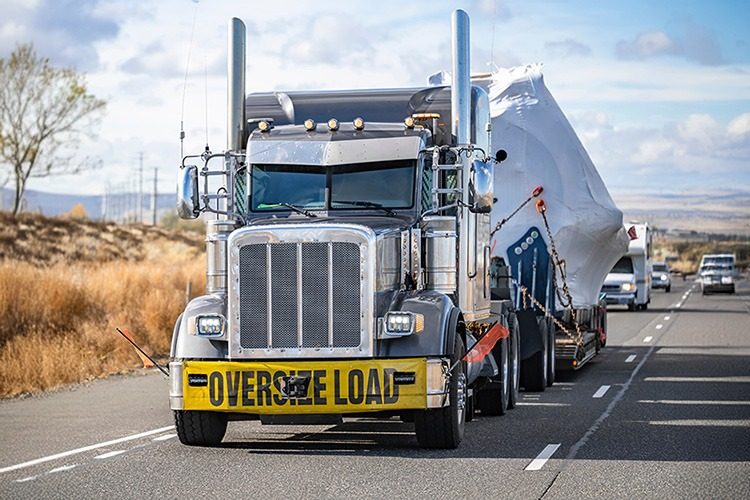
Choosing the correct trailer is essential in heavy equipment transport. The right configuration helps control height, support weight, simplify loading, and reduce delays caused by route or permit problems.
Related services include construction equipment transport, agricultural equipment transport, and commercial bus and fleet transport.
Step Deck Trailers
A step deck has an upper deck near the tractor and a lower main deck behind it. It provides more vertical clearance than a standard flatbed and works well for many legal-size machines and taller equipment.
Common uses
- Forklifts and smaller lifts
- Compact tractors
- Skid steers and compact track loaders
- Telehandlers and smaller construction equipment
- Generators and skidded equipment
Main advantage: More height clearance at a competitive cost. Main limitation: Loading may require ramps, a dock, forklift, or crane.
Lowboy Trailers
A lowboy has a very low deck, allowing taller and heavier equipment to move closer to legal height limits.
Common uses
- Bulldozers
- Excavators
- Loaders
- Cranes and crane components
- Large agricultural equipment
Main advantage: Low deck height and strong weight capacity. Main limitation: Loading method depends on the exact configuration.
RGN Trailers
An RGN is a removable gooseneck trailer. The front detaches and lowers to the ground, creating a ramp so many self-propelled machines can drive onto the deck.
Common uses
- Excavators
- Bulldozers
- Wheel loaders
- Motor graders
- Large tractors
- Asphalt pavers, rollers, and forestry equipment
Main advantage: Ground-level loading combined with a low deck. Main limitation: RGNs are specialized and usually cost more than step decks or standard flatbeds.
Quick Comparison
| Trailer | Best For | Loading |
|---|---|---|
| Step Deck | Legal-size machinery and taller freight | Dock, ramps, forklift, or crane |
| Lowboy | Tall and heavy construction equipment | Depends on configuration |
| RGN | Heavy self-propelled machinery | Ground-level drive-on loading |
How to Choose the Correct Trailer
Trailer selection should be based on dimensions, operating weight, ground clearance, operating condition, loading resources, site access, route restrictions, and permit requirements.
A running excavator may be ideal for an RGN. A crated CNC machine with crane service at both locations may move efficiently on a step deck. A tall bulldozer may require a lowboy or multi-axle RGN.
Why Accurate Specifications Matter
A few inches or several thousand pounds can change the required trailer, route, permits, and price. Provide the exact model, dimensions, weight, attachments, modifications, and current photos.
Trailer Selection Starts With Verified Specifications
The equipment name alone is not enough to select a trailer. Two excavators in the same class can have different operating weights, track widths, counterweights, booms, buckets, attachments, and transport dimensions. Use manufacturer specifications, the current configuration, and photographs of the actual machine.
Provide overall length, width, height, operating weight, ground clearance, tire or track condition, attachment details, and whether the machine can start, steer, and brake. Loading and unloading resources at both sites also matter.
Axle Configuration and Weight Distribution
Heavy equipment transport is not based only on total weight. Weight distribution across the tractor, trailer, and axle groups can change the required configuration. A multi-axle RGN or lowboy may be needed when the load is concentrated or exceeds the practical capacity of a simpler trailer.
Axle requirements, permits, escorts, and route restrictions vary by jurisdiction and shipment. Accurate weights help plan the equipment and route before dispatch.
Loading and Site Access
An RGN can provide ground-level loading for many self-propelled machines, but the site still needs room for the tractor and trailer to align, detach, load, reconnect, and exit. Low-clearance machines, disabled equipment, soft ground, steep grades, tight gates, or active construction sites may require additional planning.
Step-deck shipments often depend on a dock, forklift, crane, or suitable ramps. Confirm who provides the loading equipment, whether appointments are required, and whether the facility has operating-hour restrictions.
Legal-Size and Oversize Loads
A shipment may become oversized because of width, height, length, weight, or a combination of factors. Oversize requirements can affect routing, travel windows, permits, pilot vehicles, and final cost. Exact legal limits vary by state and local jurisdiction, so the transport plan must be based on the complete route.
Learn more about oversize load transport planning.
Trailer Selection Examples
- Compact construction equipment: A step deck may work when dimensions are legal and suitable ramps, cranes, or forklifts are available.
- Running excavator: An RGN may simplify loading because the gooseneck detaches and the machine can drive onto the deck.
- Tall bulldozer: A lowboy or RGN may help control loaded height.
- Agricultural tractor: The correct choice depends on tires, duals, attachments, height, weight, and loading access.
- Disabled equipment: A winch, crane, forklift, or other loading plan may be required regardless of trailer type.
Heavy Equipment Trailer FAQs
Is an RGN the same as a lowboy?
An RGN is a type of low-deck trailer with a removable gooseneck that creates a loading ramp. Other lowboy configurations may use different loading methods.
Which trailer is best for an excavator?
The answer depends on dimensions, weight, attachments, operating condition, ground clearance, site access, and route. Many running excavators move on RGNs, but the exact configuration must be reviewed.
Can a step deck move heavy equipment?
Yes, when the machine fits the trailer capacity and legal dimensions and appropriate loading equipment is available. Step decks are often useful for smaller machinery, forklifts, generators, and compact equipment.
Do all oversize loads require escorts?
No single rule applies to every shipment. Escort and permit requirements vary by dimensions, weight, route, and jurisdiction.
Are pickup and delivery dates guaranteed?
No. Heavy equipment schedules can change because of permits, weather, route restrictions, loading delays, equipment availability, and operating conditions.
Coordinate the Right Trailer
Elevation Transport Services coordinates nationwide heavy equipment transportation. Learn more about our Heavy Equipment Transport services or request a Specialized Transport Quote.
Backhoes may move on different trailer configurations depending on loaded height, weight, attachments, and access. Review the backhoe transport service before selecting equipment.
RGN vs Lowboy vs Step Deck: Which One Is Usually Best?
An RGN is often evaluated for tall, heavy, tracked, or self-propelled equipment that benefits from a low loading angle; lowboy configurations help reduce loaded height for heavy machinery; step decks can work for equipment that needs more vertical clearance than a standard flatbed but does not require the lowest deck. Final trailer selection depends on actual dimensions, weight, ground clearance, axle placement, loading method, and route.