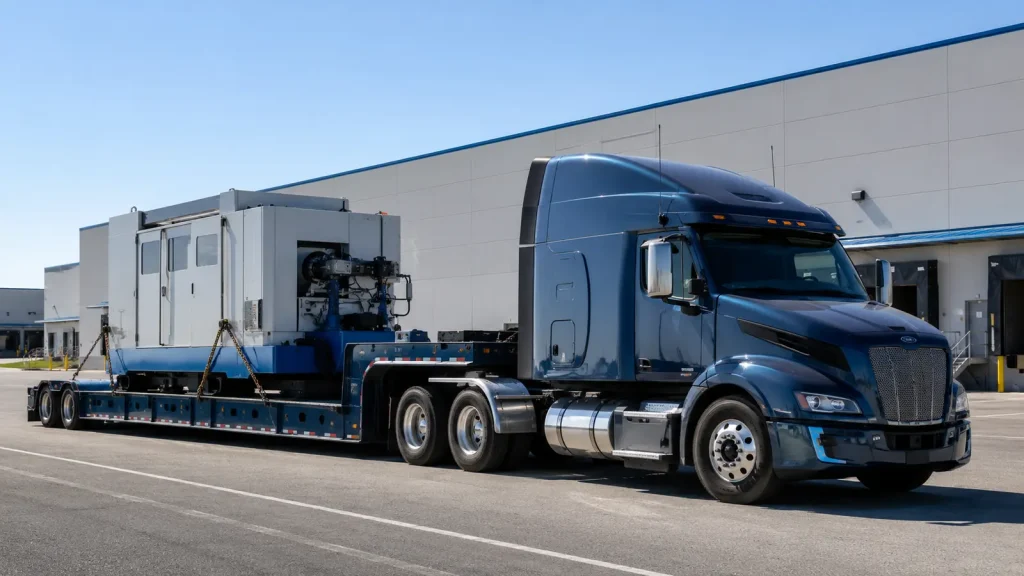
Industrial equipment shipping begins with verified dimensions, shipping weight, center of gravity, loading points, site access, and the machine’s condition at pickup. A CNC machining center, printing press, injection-molding machine, packaging line, pump skid, or other plant asset may look compact in a photograph while still creating a concentrated load that changes the trailer, axle plan, and loading method.
Many individual plant machines can move on commonly available flatbed, step-deck, double-drop, lowboy, or removable-gooseneck equipment. The correct choice depends on the complete transport profile, not the machine name alone. Ordinary oversize load transport permits or overweight permits may be required after the machine, trailer, tractor, axle weights, route, and state rules are reviewed. Loads that require extensive bridge engineering, police details, or superload routing should be treated as separate complex projects rather than routine industrial equipment moves.
In this guide:
- Information needed for an accurate quote
- Dimensions, weight, and center of gravity
- Flatbed, step-deck, double-drop, lowboy, and RGN selection
- Loading, rigging, and site responsibilities
- Securement and weather protection
- Industrial equipment shipping cost factors
- Multi-machine and plant-relocation planning
Information Needed for an Industrial Equipment Shipping Quote
A useful quote describes the machine exactly as it will be presented when the trailer arrives. Manufacturer specifications can help, but installed guards, control cabinets, conveyors, coolant tanks, platforms, tooling, piping, and custom bases may change the shipping dimensions and weight.
Provide the following whenever available:
- Manufacturer, model, serial number, and equipment type
- Verified shipping weight for the complete transport configuration
- Overall length, width, and height after approved preparation or disassembly
- Center-of-gravity information and any concentrated load points
- Base, skid, frame, lifting lugs, forklift pockets, and approved securement points
- Operating condition and whether the machine can move under its own power
- Manufacturer handling instructions, drawings, and rigging documentation
- Separate components, tooling, loose parts, fluids, batteries, or regulated materials
- Available crane, forklift, gantry, dock, skidding, or rigging resources
- Pickup and delivery addresses, appointment rules, gate dimensions, and site contacts
- Current photographs from every side, including the base and data plate
Do not estimate dimensions from a brochure image. Measure the machine in its actual transport condition on level ground, including protruding controls, electrical cabinets, access platforms, vents, hoses, guards, and attached accessories.
How the Machine Profile Changes the Transport Plan
Shipping weight and load concentration
Total weight determines trailer capacity, but concentrated weight can be just as important. A dense press, machining center, or transformer may place most of its weight across a short section of deck. The carrier must evaluate deck rating, blocking, axle distribution, and the position of the machine on the trailer. A long skid should not be assumed to distribute weight evenly.
Overall loaded height
The machine height must be combined with the trailer deck height. A unit that appears suitable for a flatbed may need a step deck, double-drop, or lowboy to control the overall profile. Removing an approved, nonstructural component can sometimes lower the load, but disassembly should follow manufacturer or qualified-rigger guidance and should be reflected in the quote.
Width, length, and projections
Control panels, operator stations, motors, conveyors, guards, and piping can extend beyond the main frame. Verify the widest and longest points in transport position. Loose or removable components should be documented as separate pieces, with their own dimensions, weights, packing method, and delivery sequence.
Center of gravity and stability
Tall machines with a narrow base can be sensitive to tipping forces. Accurate center-of-gravity information helps the loading team and carrier decide how the machine should be lifted, blocked, oriented, and restrained. Never rely on an unverified lifting eye, sheet-metal enclosure, or cosmetic frame as a structural pick or securement point.
Choosing a Trailer for Industrial Machinery Transport
The best trailer provides adequate rated capacity, usable deck length and width, acceptable loaded height, workable axle distribution, and a safe loading method. Our RGN, lowboy, and step-deck comparison explains the main equipment differences.
Flatbed trailer
A flatbed may suit lower-profile machinery, crated systems, pump skids, smaller process equipment, and components that remain within the trailer’s capacity and legal loaded dimensions. Loading normally requires a dock, crane, or suitably rated forklift because stationary plant equipment cannot simply drive onto the deck.
Step-deck trailer
A step deck provides a lower main deck than a standard flatbed and is often useful for medium-height industrial equipment. It can be practical for packaged machinery, compressors, presses, and skidded production equipment when weight concentration, deck length, loading method, and securement access are suitable.
Double-drop trailer
A double-drop trailer can provide additional height clearance in the lower well. The well length, deck rating, machine footprint, and loading method must all be checked. A tall machine may fit the vertical profile but still be unsuitable if its base does not fit the well or its concentrated weight exceeds the available configuration.
Lowboy or removable-gooseneck trailer
A lowboy or RGN offers a lower deck for taller or heavier machines. An RGN creates ground-level access, but stationary equipment still requires an approved way to reach and move across the deck. Crane loading, engineered skidding, a gantry system, rollers, or a properly rated forklift may be needed. Ground-level access does not turn a stationary machine into roll-on cargo.
Multiple trailers for a production line
A production cell may include the main machine, controls, feeders, conveyors, guarding, platforms, tooling, tanks, and spare parts. Separating those pieces can simplify the primary load, but it adds handling and sequencing requirements. Each item should appear on a master equipment list so the right trailer arrives for every piece.
Loading, Rigging, and Site Responsibilities
Transportation and rigging are related but different scopes. Elevation Transport Services coordinates the highway transportation plan and suitable carrier capacity. Crane work, machinery skidding, jacking, gantry lifting, millwright services, disconnection, disassembly, anchoring, leveling, and final installation should be identified separately and performed by qualified providers when required.
Confirm the loading method before dispatch
The site should confirm who will release the machine, who is responsible for loading and unloading, what equipment will be used, and whether the plan is approved for the actual weight and center of gravity. Forklift capacity must be evaluated at the real load center. Crane or gantry work needs qualified personnel, suitable rigging, approved pick points, adequate ground conditions, and a coordinated arrival window.
Inspect access at both facilities
Industrial yards and plants can be more restrictive than the highway route. Verify gate width and height, turning radius, dock geometry, overhead doors, power lines, piping, canopy clearance, pavement and soil condition, slopes, crane setup space, trailer staging, PPE rules, security check-in, and appointment restrictions.
If the highway trailer cannot reach the machine or final installation area, plan a legal staging location and a separate site-handling operation. A transport carrier should not be assumed to remove machinery from a building, cross an unsuitable floor, or set equipment on its foundation.
Securement and Protection for Plant Equipment
Federal cargo-securement requirements in 49 CFR Part 393, Subpart I require cargo to be contained, immobilized, or secured so it does not shift or fall during transportation. The carrier must choose blocking, chains, binders, straps, friction materials, edge protection, and anchor points appropriate to the machine and trailer.
Stationary machinery is generally evaluated under the applicable general securement requirements. Heavy equipment that operates on wheels or tracks and weighs 10,000 pounds or more is addressed specifically by 49 CFR 393.130. The exact securement method remains cargo-specific.
Good preparation may include:
- Securing moving heads, tables, doors, guards, arms, and articulated components
- Locking or supporting components according to manufacturer instructions
- Removing and separately packing approved loose parts, tooling, and accessories
- Draining or containing fluids only when required by the manufacturer or applicable rules
- Protecting controls, precision surfaces, sensors, wiring, and openings
- Using structural base or manufacturer-approved securement points
- Keeping chains and straps away from fragile panels, tubing, and control cabinets
- Documenting preexisting condition with dated photographs
Tarps, shrink wrap, and enclosures
Weather protection should be specified before pricing. A standard tarp can rub against sharp corners, paint, sensors, or projecting controls, while ordinary plastic wrap may trap moisture or fail at highway speed. Sensitive machines may need manufacturer-approved wrapping, crating, desiccants, barrier film, or an enclosed solution arranged before loading. The protection method must not conceal securement problems or interfere with required inspections.
Permits and Route Planning
Some industrial machines remain within routine legal dimensions and weights after the trailer is selected. Others require ordinary oversize or overweight permits. The decision must be based on the complete loaded combination, axle weights, route, and each state’s rules. The FHWA permit overview explains that oversize and overweight permits are administered by individual states.
Pilot cars, restricted travel windows, or special routing conditions are not automatic. They depend on the loaded measurements, weight, route, jurisdiction, and permit terms. Accurate specifications provided early help distinguish a practical permitted move from an extreme project that needs additional engineering and coordination.
Industrial Equipment Shipping Cost Factors
There is no responsible flat rate based only on mileage or machine value. The main cost factors include:
- Verified dimensions, shipping weight, and center of gravity
- Trailer type, deck requirements, axle configuration, and equipment availability
- Loaded miles, route conditions, origin and destination markets, and timing
- Crane, forklift, rigging, skidding, dock, or loading-assistance requirements
- Permits, travel restrictions, route review, and any required pilot vehicles
- Site appointments, security onboarding, detention risk, and access limitations
- Crating, tarping, wrapping, climate protection, or shipment-specific handling
- Disassembly, separate components, and multiple coordinated loads
- Operating condition and readiness when the carrier arrives
For broader budgeting context, review our heavy equipment transport cost guide. The most reliable quote starts with verified specifications, current photographs, loading responsibilities, exact locations, site-access details, and the intended shipping date.
Multi-Machine Moves and Plant Equipment Relocation
A plant relocation should be planned from a complete equipment list rather than a series of unrelated dispatches. Group items by origin area, release date, destination area, unloading method, trailer requirement, and installation priority. Identify which machines can ship together, which require dedicated trailers, and which accessories must arrive before the main equipment can be installed.
Useful project controls include a unique load number for every trailer, a packing list, dimensions and weight for each item, pickup and delivery contacts, photographs, required documents, and an agreed sequence. Buffer time may be needed between rigging, loading, highway transport, unloading, and installation. Dates should remain realistic and shipment-specific because permits, access, loading readiness, weather, and carrier availability can affect the plan.
For coordinated plant and machinery moves, see our commercial bus and fleet transport services. Power-generation equipment can also be reviewed in our industrial generator transport guide, while construction fleets and self-propelled machinery are covered by our heavy equipment transport services.
Industrial Equipment Shipping FAQs
What types of industrial equipment can be shipped by truck?
Common candidates include CNC machines, presses, injection-molding machines, packaging equipment, pump and compressor skids, printing equipment, chillers, process equipment, control cabinets, and production-line components. Exact suitability depends on dimensions, weight, condition, loading method, site access, and the available trailer.
What trailer is best for industrial machinery?
Flatbeds and step decks can work for suitable lower-profile units. Taller or heavier machines may fit better on a double-drop, lowboy, or RGN. The final choice depends on the machine’s complete profile, concentrated weight, loading method, axle distribution, and route.
Does Elevation Transport Services provide machinery rigging?
Elevation Transport Services coordinates the transportation portion of the move. When crane, rigging, millwright, skidding, disassembly, or installation work is required, that scope should be identified separately and assigned to qualified providers.
Will industrial equipment need an oversize permit?
Not always. Permit requirements depend on the complete loaded dimensions and weights, trailer and tractor configuration, axle distribution, route, state rules, and permit conditions. Shipment-specific verification is required.
Can a stationary machine load onto an RGN from the ground?
An RGN offers ground-level deck access, but a stationary machine still needs an approved loading method. Depending on the machine, that may involve a crane, gantry, engineered skidding, rollers, or a suitably rated forklift.
What information prevents quote changes and delays?
Provide verified shipping dimensions and weight, center-of-gravity and handling information, current photos, exact addresses, site restrictions, loading and unloading responsibilities, separate-component details, timing, and any special protection requirements.
Request an Industrial Equipment Shipping Quote
Elevation Transport Services coordinates nationwide shipping for plant machinery, production equipment, skidded industrial systems, compressors, pumps, and related specialty freight. Send the machine type, verified dimensions and weight, center-of-gravity or lifting information, photos, loading method, site-access details, locations, and requested timing for a shipment-specific review.
Visit our specialized transport quote form or call (800) 251-9024.
Trailer availability, pricing, routing, permits, escorts, scheduling, and loading requirements depend on the actual equipment, route, site access, readiness, and applicable regulations.
Shipping a warehouse or high-capacity lift truck? Our forklift transport guide explains mast measurements, trailer selection, operating condition, loading access, power-source preparation, permits, and multi-unit fleet planning.
Planning a pickup or delivery in South Florida? Read our Boca Raton heavy equipment shipping guide for local site access, trailer selection, quote requirements, and permit planning.
Moving a skid-mounted or packaged compressor? Our industrial air compressor transport guide covers trailer selection, loading access, pressure and utility preparation, cost factors, and shipment-specific permit review.
Need to Move Industrial Equipment?
Send the machine type, verified dimensions and weight, photos, loading method, site access, locations, and timing for a shipment-specific transport review.