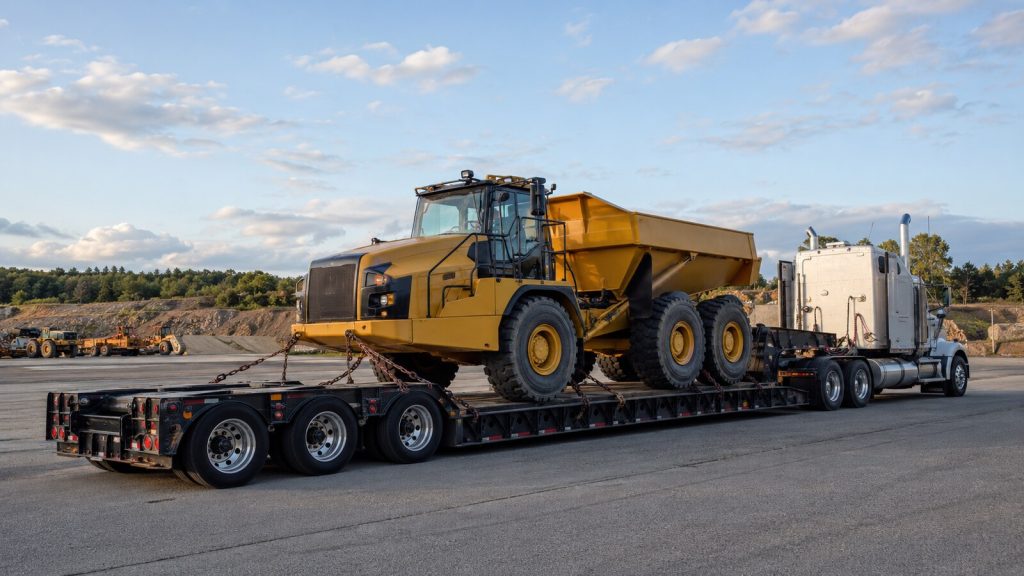
Articulated dump trucks—also called articulated haul trucks or ADTs—combine large tires, an oscillating articulation joint, and a high-capacity dump body for work on construction sites, mines, quarries, land-clearing projects, and challenging terrain. Moving one between a dealer, auction, jobsite, or equipment yard requires more than booking a standard flatbed. The machine’s actual dimensions, empty operating weight, tire profile, articulation lock, loading access, and route all affect the transport plan.
Elevation Transport Services coordinates nationwide articulated dump truck transport for contractors, dealers, rental fleets, auctions, quarry operators, and equipment owners. Our focus is on practical RGN and lowboy moves for compact and mid-size machines, with larger units evaluated individually according to their loaded dimensions, axle weights, origin, destination, and state requirements.
Articulated Dump Truck Transport at a Glance
| Planning item | Typical consideration |
|---|---|
| Common cargo | Articulated dump trucks and articulated haul trucks moving empty |
| Likely trailer | RGN or lowboy; multi-axle equipment may be required as weight increases |
| Loading method | Drive-on loading when the machine safely runs, steers, and brakes; assisted loading for non-running units |
| Information required | Year, make, model, exact dimensions, empty weight, operating condition, photos, and site-access details |
| Permit planning | Shipment-specific; loaded height, width, length, axle weight, route, and state rules control requirements |
Why ADTs Require Specialized Trailer Planning
An ADT is built to move heavy material off-road, but that does not mean it can travel efficiently or legally over long highway distances. Its large flotation tires, tall cab, wide dump body, concentrated weight, and long wheelbase can create a load that exceeds ordinary legal dimensions once placed on a trailer.
Published manufacturer specifications illustrate how much models can differ. Caterpillar lists an empty operating weight of approximately 50,949 pounds for a 725, about 51,831 pounds for a 730, and approximately 72,995 pounds for a 745. Those figures are examples only. Options, guarding, tailgates, liners, onboard systems, attachments, fuel level, and machine configuration can change the shipping profile. The equipment identification plate and model-specific documentation should always be used for quoting.
The transport plan also has to account for how the machine’s weight is distributed across the trailer and tractor axles. A trailer that has enough deck capacity in general may still be unsuitable if the resulting axle distribution does not work for the planned route.
RGN, Lowboy, or Another Trailer?
Most articulated dump truck moves are evaluated for an RGN or lowboy because these trailers provide the lower deck height and higher-capacity configurations commonly needed for heavy, tall equipment. The final selection cannot be made from the equipment name alone.
Removable gooseneck trailer
An RGN allows the front of the trailer to detach and lower toward the ground. A properly operating ADT may then be driven onto the deck, subject to the carrier’s loading procedure, ramp angle, ground conditions, and available clearance. This can be especially useful at locations without a loading dock.
Lowboy trailer
A lowboy’s low deck helps control overall loaded height. Fixed-neck or detachable configurations may be considered depending on the machine, available loading assistance, weight, and site access. Axle count and deck rating must match the complete transport plan.
Multi-axle configurations
Heavier machines may require additional trailer axles or a different tractor-trailer configuration to distribute weight. That decision should follow confirmed machine specifications and route review—not a generic model description.
For a comparison of these equipment types, see our RGN, lowboy, and step-deck trailer guide.
Information Needed for an Accurate ADT Shipping Quote
A useful quote starts with verified information. Provide the following whenever possible:
- Year, manufacturer, and exact model number
- Overall length, width, and height in transport configuration
- Empty operating weight and any installed options
- Clear photographs from all four sides
- Whether the dump body is empty, fully lowered, and secured
- Whether the truck starts, runs, steers, and brakes
- Any leaks, tire problems, or mechanical restrictions
- Pickup and delivery addresses, site hours, and contact information
- Surface conditions and space available for a tractor-trailer
- Required pickup window and delivery restrictions
Do not rely on a model family or advertised payload capacity as the shipping weight. Payload rating describes material-carrying capability; the carrier needs the machine’s empty transport weight and actual configuration.
Preparing an Articulated Dump Truck for Transport
Empty and clean the dump body
The machine should be free of material, loose debris, and unsecured tools. Mud and aggregate can add weight, obscure tie-down areas, and fall from the machine during transport.
Lower and secure moving components
The dump body should be fully lowered unless the manufacturer or loading plan requires another approved position. Steps, mirrors, antennas, fire extinguishers, cameras, and other vulnerable or removable components should be identified before pickup.
Confirm articulation control
Many ADTs use an articulation lock or steering-frame locking device for service or transport procedures. The correct manufacturer instructions should be followed. The driver and equipment contact should confirm how the machine will be controlled during loading and securement.
Check tires, leaks, and operating condition
A soft or damaged tire can change loaded height, prevent controlled loading, and complicate securement. Active fluid leaks should be repaired or disclosed before dispatch. If the machine does not run, steer, or brake as expected, tell the transport coordinator before a carrier is assigned.
Provide safe loading access
An RGN combination needs firm, level space to detach, align, load, reconnect, and exit. Tight gates, steep entrances, soft ground, overhead lines, low tree limbs, parked equipment, and restricted operating hours should be disclosed with photos.
How Articulated Dump Truck Transport Cost Is Calculated
There is no responsible flat price for shipping every ADT. The quote depends on the complete load and route. The largest cost factors usually include:
- Machine dimensions and empty weight: These determine usable trailer configurations and whether the loaded combination exceeds legal limits.
- Distance and route: Total mileage matters, but route restrictions, urban access, terrain, tolls, and available legal roads may matter as much as distance.
- Trailer and axle requirements: A standard configuration generally costs less than higher-capacity multi-axle equipment.
- Operating condition: A machine that safely drives onto an RGN is usually easier to handle than one requiring a winch, tow unit, crane, or additional loading equipment.
- Permits and route conditions: Oversize or overweight permits, travel-hour limitations, and other state conditions affect carrier planning.
- Pickup and delivery access: Restricted sites, appointments, limited staging room, or difficult ground conditions can affect the carrier and loading plan.
- Market timing: Carrier availability, fuel costs, season, weather, and the amount of advance notice can influence a quote.
A low initial number based only on mileage can change once the correct dimensions, trailer, permits, or loading needs are discovered. The best way to obtain a useful price is to send the exact model, specifications, photos, route, condition, and site details at the beginning.
Permit Complexity for ADT Moves
Articulated dump trucks commonly create low-to-moderate permit complexity for the types of moves Elevation Transport Services targets, but that is not a guarantee for any particular machine. A larger model, unusual configuration, restricted route, or high axle weight can require additional planning.
Permit needs depend on the complete loaded combination—not simply the truck’s standalone specifications. Overall height includes the trailer deck and tire position. Overall width may be affected by tires, mirrors, handrails, guards, or other components. Weight must be distributed across the tractor and trailer axles.
States issue oversize and overweight permits under their own rules and may impose route, travel-time, weather, lighting, signage, or escort conditions. The Federal Highway Administration’s permit overview explains the state-administered nature of these requirements. No article or preliminary quote should be treated as a permit determination for a specific shipment.
Securement and Condition Documentation
Heavy vehicles and machinery must be secured using equipment and methods appropriate for the load. The carrier is responsible for the final securement plan, working-load limits, attachment points, blocking, and compliance with applicable regulations. Federal requirements for heavy vehicles, equipment, and machinery are addressed in 49 CFR 393.130.
Photograph the ADT before loading, including the cab, body, tires, steps, mirrors, articulation area, and any existing damage. The pickup and delivery condition should also be recorded on the bill of lading or condition report.
Who Uses Articulated Haul Truck Shipping?
Common customers include civil and site contractors, quarry and aggregate operators, equipment dealers, auction buyers, rental companies, land-clearing contractors, mines, municipalities, and fleet managers. Typical moves include dealer deliveries, auction purchases, project transfers, lease returns, repair-facility moves, and relocation between equipment yards.
Customers moving several machines should provide an equipment list showing each unit’s model, dimensions, weight, condition, and route. Multi-unit moves are coordinated according to actual trailer capacity and carrier availability rather than assuming every machine can share the same load.
Articulated Dump Truck Transport FAQs
What trailer is normally used to ship an articulated dump truck?
An RGN or lowboy is commonly considered because of the machine’s height, weight, tires, and loading requirements. Exact dimensions, weight distribution, ground clearance, and site access determine the final trailer.
Can an ADT drive onto an RGN trailer?
Often, when the machine safely starts, runs, steers, and brakes and the carrier approves the loading method. Ramp angle, ground conditions, machine clearance, tire condition, and available space must be evaluated first.
Can a non-running articulated dump truck be transported?
Potentially, but the condition must be described accurately. Confirm whether it rolls, steers, and brakes, and identify any damaged or flat tires. Appropriate winching, towing, lifting, or loading assistance must be arranged before pickup.
Do articulated dump trucks require permits?
Some do, but the answer depends on the complete loaded dimensions, axle weights, trailer configuration, route, and states traveled. Exact shipment information is required before making a permit determination.
Should the dump body be raised for transport?
Normally the body should be empty and fully lowered, subject to the manufacturer’s procedures and the carrier’s loading plan. Never move or secure the body in an improvised position simply to change dimensions.
How far ahead should I request a quote?
Provide the shipment details as early as practical, especially for heavier models, restricted jobsites, auctions, or routes that may need permits. Pickup and delivery windows remain estimates and depend on carrier availability, weather, traffic, permits, site readiness, and other operational conditions.
Request an Articulated Dump Truck Transport Quote
Send the year, manufacturer, model, exact dimensions, empty weight, operating condition, photos, pickup location, delivery location, and preferred shipping window. Elevation Transport Services will evaluate the equipment profile, loading requirements, likely trailer configuration, and route before presenting transport options.
Request a specialized equipment transport quote for an articulated dump truck, haul truck, or related construction machine.
Articulated dump trucks are part of our broader construction equipment transport work. For specialized trailer and heavy-haul coordination, also review our heavy equipment transport service.