Accurate motorcoach measurements help prevent unsuitable equipment assignments, loading delays and avoidable route changes. Measure the coach in its actual pickup configuration because mirrors, rooftop equipment, suspension position and body overhang can change the transport profile.
This guide is for motorcoach dealers, charter operators, fleet managers and organizations preparing a coach for trailer transport. It supports the planning process used for motorcoach transport and larger commercial bus and fleet moves.
Before You Measure the Coach
Park the motorcoach on firm, level ground with enough room to walk around it safely. Use a tape measure or laser measuring tool suitable for the distance, and have a second person verify the endpoints. Record measurements in feet and inches, and do not round a dimension down.
Use the coach’s normal pickup configuration. If mirrors fold, an antenna retracts or the suspension changes height, record both the current position and the transport-ready position. Do not remove or alter equipment solely for transport unless the owner approves it and qualified personnel perform the work.
Motorcoach Measurement Checklist
| Item | What to record | Why it matters |
|---|---|---|
| Overall length | Furthest fixed front point to furthest fixed rear point | Trailer fit, deck space and overhang review |
| Overall width | Widest body or fixed accessory point; note mirror position | Equipment and route planning |
| Overall height | Level ground to the highest fixed rooftop point | Loaded-height and clearance review |
| Approximate weight | Verified scale weight, data plate or manufacturer specification; identify estimates | Trailer and capacity planning |
| Wheelbase | Center of front axle to center of rear axle group | Deck placement and loading geometry |
| Ground clearance | Lowest points at the front, center and rear | Loading angle and ramp review |
| Front and rear overhang | Axle centerline to the furthest body point | Breakover and tail-swing planning |
How to Measure Overall Length
Measure in a straight line from the furthest fixed point at the front of the coach to the furthest fixed point at the rear. Include permanently mounted components such as bumpers or rear equipment housings. Record removable items separately.
Also measure the front and rear overhang from the nearest axle centerline. A motorcoach can have substantial bodywork beyond the axles, so overall length alone does not describe how the coach will approach a ramp or sit on a trailer.
How to Measure Width
Measure the widest fixed point on the body. State whether the mirrors are fixed, powered, manual-folding or removable, and provide the width with the mirrors in their pickup position. Photograph any accessories or bodywork that extend beyond the main sidewall.
Do not assume that the factory width still applies. Repairs, aftermarket equipment and mounted accessories can change the actual dimension that must be reviewed.
How to Measure Height
Measure from level ground to the highest fixed point. Check rooftop HVAC units, antennas, satellite equipment, emergency hatches and other roof-mounted components. A photograph taken from the side and another showing the roofline can help identify the true highest point.
Record the motorcoach suspension position at the time of measurement. If the coach has air suspension or a kneeling system, state whether it starts, builds air and reaches its normal travel height. The carrier must evaluate the coach height together with the trailer deck to determine the complete loaded profile.
Weight, Wheelbase and Axle Information
Provide the best verified weight available. A recent scale ticket is strongest when available; otherwise use the vehicle data plate or a manufacturer specification tied to the exact model and configuration. Label any number that is only an estimate.
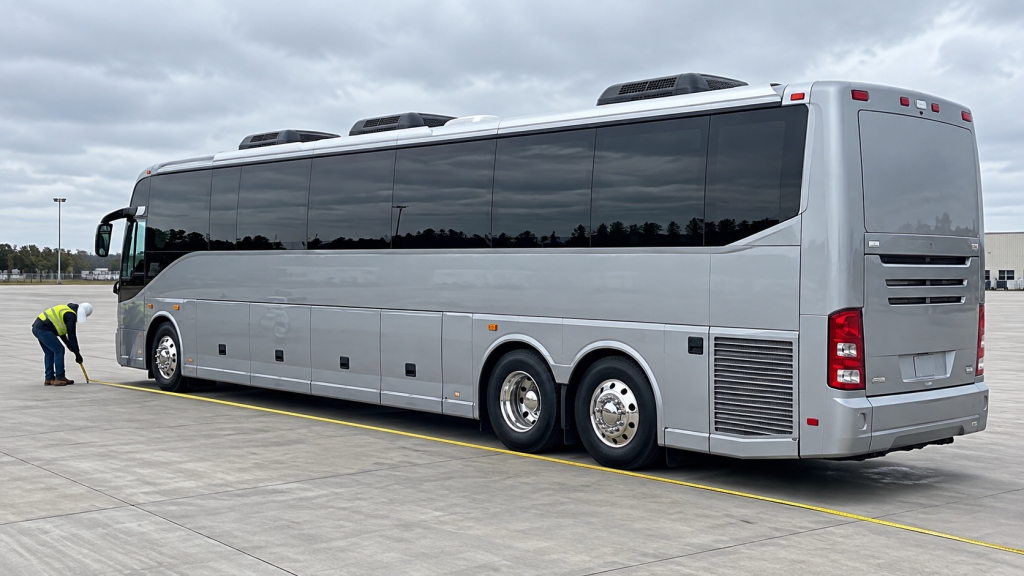
Record the wheelbase and axle arrangement, including tag or lift axles. Clear photographs of each side help show axle locations and the coach’s relationship between wheelbase, overhang and body length.
Ground Clearance and Loading Angles
Ground clearance should be checked at more than one point. Measure the lowest fixed areas near the front bumper, entrance steps, undercarriage, axle area and rear bodywork. Note low-hanging components or damaged panels that could contact a ramp.
Photograph each low-clearance point with the coach on the same surface used for measurement. If the pickup area is sloped, soft or uneven, disclose that separately because site conditions can affect loading.
Confirm Operating Condition
For transport planning, “running” should mean more than the engine starting. Confirm whether the motorcoach:
- Starts and remains running
- Builds and holds air pressure
- Raises to its normal travel height
- Releases the parking brake
- Rolls, steers and stops under its own controls
- Has inflated tires and functioning wheels
- Has keys and accessible battery controls
Disclose leaks, damaged bodywork, flat tires, locked brakes, steering problems, missing keys and disabled suspension before equipment is assigned.
Photos to Send With the Measurements
- Full front and rear views
- Complete driver and passenger sides
- Roofline and highest rooftop equipment
- Front and rear overhang
- Lowest ground-clearance points
- Each axle and tire group
- VIN or fleet identification
- Existing damage or loose components
- Pickup and delivery access areas
Measure the Pickup and Delivery Sites Too
The coach may be ready while the site is not. Confirm gate width, overhead clearance, turning room, surface condition, grade, facility hours and any appointment or driver-identification requirements. Identify overhead wires, tree limbs, canopies, tight entrances and parking areas that may restrict a tractor-trailer.
For multi-coach projects, provide one row per unit with its VIN or fleet number, dimensions, condition, origin, destination and release status. Our motorcoach fleet planning guide explains how dealers and operators can organize delivery and intake details.
Information to Include in the Quote Request
Send the year, make, model, VIN or fleet number, complete dimensions, weight source, operating condition, photographs, pickup and delivery contacts, site-access notes and preferred timing. Pricing is also affected by distance, equipment requirements, route and availability; see the commercial bus transport cost guide for the main planning factors.
Request a Motorcoach Transport Review
Elevation Transport Services coordinates nationwide motorcoach and commercial bus transportation through qualified motor carriers. Submit the coach details through the transport quote form, or call 800-251-9024 to review a single coach or multi-unit fleet move.