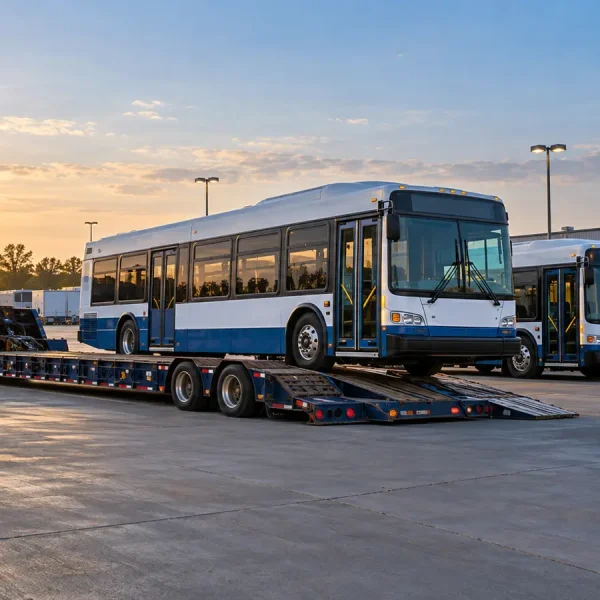
Commercial bus transport cost depends on the bus, the route, and the loading plan. A short shuttle bus that can move on a standard trailer is priced very differently from a full-size school bus, transit bus, or motorcoach that requires a low-profile trailer, state permits, route review, or escort vehicles.
There is no responsible flat rate for moving a commercial bus. Published transport-company estimates vary widely because some refer to driveaway service, others to deck transport, and many do not include the same trailer, permit, escort, loading, or access assumptions. A shipment-specific quote should be based on the exact unit and route rather than a generic national average.
Elevation Transport Services coordinates commercial bus shipping and fleet vehicle transport nationwide for dealers, schools, municipalities, shuttle operators, charter companies, fleet owners, manufacturers, and commercial buyers. This guide explains where the money goes and what information produces a dependable quote.
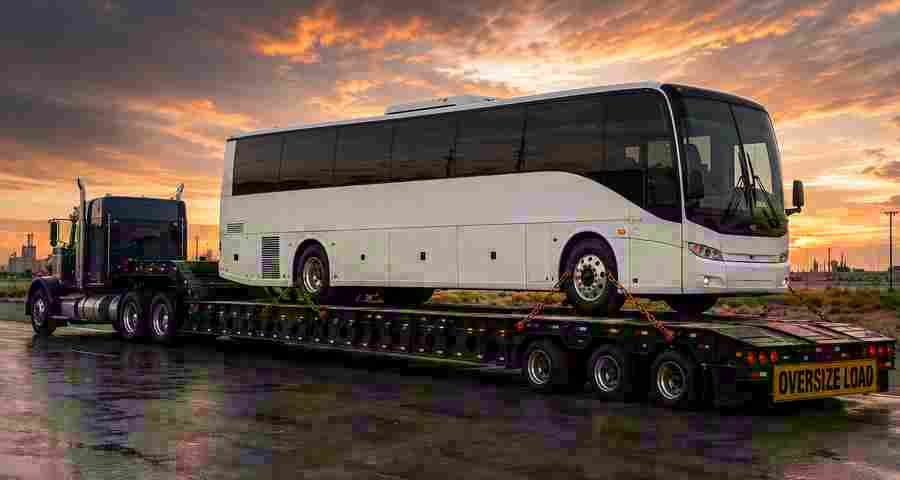
Commercial Bus Transport Cost at a Glance
| Example shipment | Pricing approach | What can change the price |
|---|---|---|
| Small shuttle bus, about 300 miles | Shipment-specific quote | Unit size, operating condition, trailer availability, and access |
| Minibus or school bus, 500–1,000 miles | Shipment-specific quote | Loaded height, route, permits, loading method, and timing |
| Full-size school or transit bus, 1,000–2,000 miles | Shipment-specific quote | Trailer type, legal dimensions, permits, tolls, and deadhead |
| Large motorcoach or specialty bus, cross-country | Shipment-specific quote | Length, weight, loaded height, escorts, route restrictions, and equipment |
Fuel conditions, carrier capacity, season, locations, vehicle condition, trailer requirements, and shipment specifications can materially change an individual quote.
The Seven Biggest Bus Shipping Cost Factors
1. Exact bus dimensions and weight
Length, width, height, wheelbase, ground clearance, curb weight, and any rooftop equipment affect trailer selection and the loaded dimensions. A shuttle bus built on a commercial van chassis may fit a step deck. A full-size school bus or motorcoach may need a lowboy, removable gooseneck, double-drop, or another configuration that keeps the total height within the route’s limits.
Do not rely on the model name alone. Passenger capacity, wheelchair lifts, air-conditioning units, battery packs, luggage bays, aftermarket accessories, and conversions can change the shipping profile.
2. Distance and route
Total mileage matters, but distance is not the only route expense. A carrier may need to travel empty to reach the pickup. Tolls, fuel, mountain grades, congested corridors, limited truck access, and a delivery point far from regular freight lanes can all affect the rate.
Longer trips often cost less per loaded mile than short moves because fixed expenses are spread across more miles. The total price, however, is still higher on a cross-country shipment.
3. Deck transport versus driveaway
A roadworthy commercial bus can sometimes be moved by a qualified driveaway operator. Deck transport keeps mileage off the bus and may be preferred for auction purchases, non-registered units, new inventory, high-value coaches, buses with uncertain mechanical condition, or shipments where the customer does not want the unit driven.
The correct option depends on the bus, insurance arrangements, route, condition, timing, and customer requirements. The method should be agreed upon before dispatch rather than assumed from the quote request.
4. Operating condition and loading method
An inoperable bus usually costs more to transport because loading requires more planning. The carrier needs to know whether the bus rolls, steers, brakes, starts, moves under its own power, and can build air pressure if it uses air brakes.
If it cannot self-load, the plan may require a winch-capable trailer, loading dock, tow assistance, forklift, or crane. Pickup and delivery parties should agree in advance on who provides any equipment that is not part of the transport trailer.
5. Permits, route review, and escorts
The Federal Highway Administration identifies 102 inches, or 8 feet 6 inches, as the standard maximum width on the National Network. Once the loaded bus and trailer exceed a state’s legal limits for width, height, length, or weight, permits and route-specific conditions may apply. The federal government does not issue oversize or overweight permits; those permits are handled by states and, in some cases, local jurisdictions.
Permit fees are only one part of the added cost. A permitted move may also require restricted travel hours, warning equipment, route surveys, escort vehicles, or extra time to avoid low clearances and restricted roads. Requirements vary by state and by the final loaded configuration. See the FHWA commercial vehicle size regulations and FHWA permit overview for federal background.
6. Pickup and delivery access
A trailer that can legally travel the highway may still be unable to enter a school yard, storage lot, auction lane, gated facility, residential street, or downtown property. Low branches, narrow turns, soft ground, parked vehicles, overhead wires, weight restrictions, and limited staging space can force a safer nearby meeting point or require different loading arrangements.
Clear photos and accurate access notes reduce the risk of a failed pickup, added tow bill, or last-minute equipment change.
7. Timing, season, and truck availability
Flexible pickup windows generally create more carrier options than an urgent or fixed-date request. Summer fleet turnover, school procurement cycles, severe weather, holiday schedules, and regional capacity can affect availability. Pickup and delivery windows are estimates and depend on carrier availability, weather, traffic, permits, route conditions, and other operational factors.
What Types of Commercial Buses Can Be Transported?
- Shuttle buses and minibuses: hotel, airport, senior-living, church, campus, and parking-facility units.
- School buses: Type A, conventional, and larger transit-style school buses.
- Motorcoaches and charter buses: full-size passenger coaches with luggage compartments and rooftop systems.
- Transit buses: municipal, airport, campus, and private-fleet transit vehicles.
- Specialty buses: party buses, mobile offices, command vehicles, bookmobiles, and custom passenger units.
- Commercial vans and fleet vehicles: Sprinter-style vans, passenger vans, work vans, and mixed fleets.
Battery-electric buses require special attention to curb weight, battery state, charging or recovery procedures, and the manufacturer’s towing and securement instructions. Alternative-fuel buses also require accurate fuel-system information before transport equipment is assigned.
Which Trailer Is Used to Ship a Bus?
There is no single “bus trailer.” The selection depends on the bus and the loaded profile.
- Step deck: useful for smaller shuttle buses and commercial vans when height and ramp angle work.
- Lowboy or double drop: lowers the deck height for taller buses and coaches.
- Removable gooseneck (RGN): allows the front of the trailer to detach so a roadworthy unit can be driven onto the deck, subject to clearance and weight.
- Specialized low-profile equipment: may be required for long, tall, or heavy transit buses and motorcoaches.
The trailer name alone does not determine suitability. Usable deck length, well length, deck height, ramp angle, axle capacity, securement points, and the final loaded dimensions all have to work together. For a closer look at trailer differences, read our RGN vs. lowboy vs. step deck guide.
How to Get a More Accurate Commercial Bus Transport Quote
Send the following information with the first request:
- Year, make, model, and passenger capacity
- Verified overall length, width, height, wheelbase, and curb weight
- Current photos from the front, rear, both sides, and roofline
- VIN or specification sheet when available
- Whether the bus starts, runs, drives, steers, brakes, and builds air pressure
- Ground clearance and any low body panels, steps, lifts, or overhangs
- Rooftop air-conditioning units, antennas, signs, exhaust stacks, or accessories
- Exact pickup and delivery locations
- Site hours, appointment rules, loading equipment, and access limitations
- Requested pickup window and any operational deadline
- Number of buses and whether all units are identical
Auction listings and dealer advertisements are helpful, but their dimensions are not always the transport dimensions. Verified measurements protect the schedule and the price.
Can Multiple Buses Be Moved as a Fleet?
Yes. A fleet move should be organized by unit type, dimensions, operating condition, origin, destination, and delivery priority. Identical shuttle buses may allow repeatable equipment planning, while a mixed fleet may require several trailer types or a combination of deck transport and driveaway service.
For dealerships, schools, municipalities, rental operators, and shuttle companies, a consolidated unit list makes quoting faster. Include one row per vehicle with the VIN, specifications, condition, location, contact, and requested sequence.
Commercial Bus Transport Cost FAQs
Is a commercial bus priced strictly by the mile?
No. Mileage is important, but bus size, trailer type, permits, deadhead, operating condition, route, access, and timing can have equal or greater impact. A simple per-mile number without the unit specifications can be misleading.
Does an inoperable bus cost more to transport?
Usually. A bus that cannot start, steer, brake, roll, or build air pressure may require a winch, tow assistance, loading equipment, extra labor, or a different trailer. Describe the condition accurately before a carrier is assigned.
Can personal or fleet property stay inside the bus?
Do not assume loose property is covered or permitted. Any approved items must be disclosed, secured, and kept within the written terms. Personal property is generally not covered by motor-carrier cargo insurance.
How far in advance should a bus shipment be booked?
Provide as much notice as practical, especially for a large coach, inoperable unit, multi-bus fleet, rural location, or permit-sensitive route. Flexible dates help, but pickup and delivery windows remain estimates and depend on carrier availability, weather, traffic, permits, route conditions, and other operational factors.
What is the fastest way to receive a quote?
Provide verified dimensions and weight, current photos, condition, exact locations, access details, and the requested pickup window in the first submission. Missing height or weight information is one of the most common reasons a commercial-bus quote cannot be finalized.
Request a Commercial Bus Transport Quote
Elevation Transport Services coordinates nationwide shipping for shuttle buses, school buses, transit vehicles, motorcoaches, commercial vans, and multi-vehicle fleets. We review the actual unit, route, access, operating condition, and loading requirements before matching the shipment with an appropriate transport plan.
Plan Your Commercial Bus Shipment
Get a shipment-specific review based on the bus, route, condition, and access—not a generic car-shipping estimate.
REQUEST A COMMERCIAL BUS QUOTE
Or call (800) 251-9024.
Final pricing, equipment, permits, escorts, route, pickup, and delivery timing depend on the exact bus, condition, locations, access, market availability, and applicable requirements. Pickup and delivery windows are estimates.
For manufacturer-specific school-bus planning, see our Blue Bird school bus transportation guide. For the full service overview, visit Commercial Bus & Fleet Transport.
For shipment-specific service, compare School Bus Transport, Shuttle Bus Transport, Motorcoach Transport, and Multi-Vehicle Fleet Transport.
What Affects Commercial Bus Transport Cost?
Commercial bus transport cost depends on bus size, weight, ground clearance, operating condition, transport method, distance, route, quantity, site access, and whether permits or loading assistance are required. Full-size motorcoaches and school buses can require a different equipment plan than cutaway shuttles or smaller commercial vehicles.