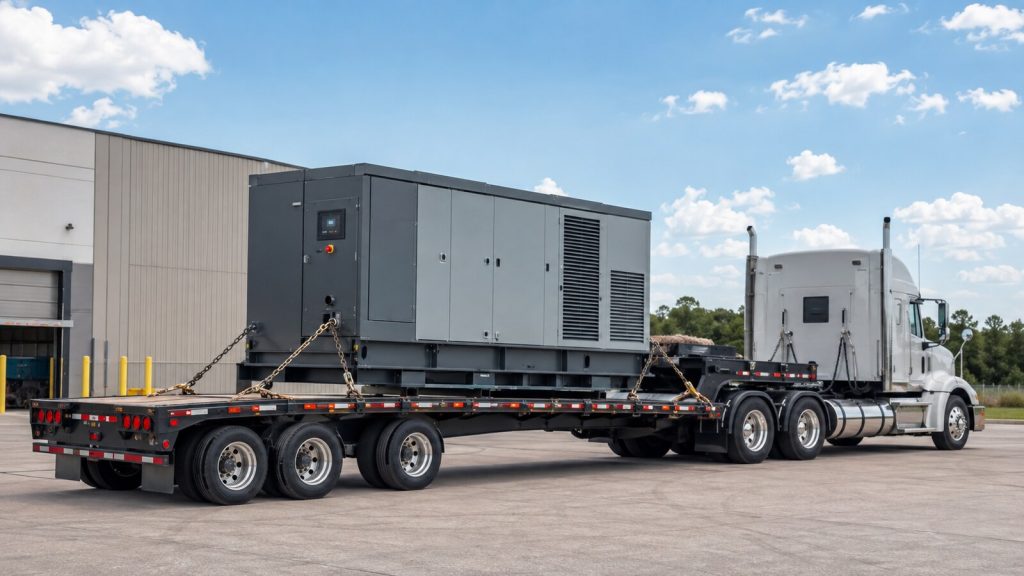
Industrial air compressor transport starts with more than finding an open trailer. A packaged compressor can combine a heavy steel skid, enclosure, motor or engine, receiver, cooler, controls, and vulnerable service connections in one concentrated load. The right plan accounts for verified shipping dimensions, weight, center of gravity, loading method, site access, and route before a truck is assigned.
Elevation Transport Services coordinates nationwide heavy equipment transport for stationary compressor packages, compressor skids, portable construction compressors, rental-fleet units, and related commercial equipment. This guide explains the practical information commercial buyers should gather before requesting a quote, how common trailer options compare, and which shipment details can affect cost or permitting.
What Types of Air Compressors Can Be Transported?
Industrial compressors differ substantially from the small shop units moved in a pickup truck. Commercial shipments may include equipment purchased from a manufacturer or dealer, moved between plants, returned from a rental project, sold at auction, or relocated as part of a larger facility project.
- Packaged rotary screw compressors: enclosed electric- or engine-driven units used in manufacturing, processing, and construction applications.
- Reciprocating compressor packages: compressor, motor, receiver, and controls mounted on a common frame or skid.
- Skid-mounted compressor systems: compressor packages assembled with coolers, separators, dryers, piping, or control panels.
- Portable construction compressors: towable units that may be loaded onto a trailer when deck transport is safer or more practical than towing.
- High-capacity rental units: individual machines or multiple units moving between branches, projects, and customer sites.
- Associated equipment: air receivers, dryers, aftercoolers, hose reels, loose accessories, and separately prepared support components.
Extremely large process modules can require specialized engineering and superload planning. This guide covers compressor packages evaluated for flatbed, step-deck, double-drop, lowboy or RGN transport. The actual shipping configuration, loading method and route determine which equipment can be considered.
Information Needed for an Accurate Compressor Shipping Quote
A model number alone is useful, but it is not a substitute for shipment-specific measurements. Accessories, sound enclosures, modified skids, receivers, exhaust components, and field-installed piping can make the current shipping configuration different from a catalog specification.
Provide the following information when requesting an air compressor shipping quote:
- Manufacturer, model, serial number if available, and equipment type
- Verified overall length, width, and height in the exact shipping configuration
- Verified weight in the shipping configuration, including the skid and attached accessories
- Photos from all four sides plus the base, lifting points, and any damaged areas
- Skid dimensions, ground clearance, lifting-eye locations, and known center-of-gravity information
- Whether the unit runs, rolls, steers, or is designed to be towed
- Whether a loading dock, crane, forklift, rigging team, or other loading equipment is available at each location
- Pickup and delivery addresses, site hours, gate restrictions, surface conditions, and overhead-clearance concerns
- Information about receivers, fluids, fuel, batteries, loose hoses, cables, piping, or detached components
- Requested pickup window and any fixed plant, shutdown, auction, or project deadline
Accurate details allow the transport coordinator and carrier to compare trailer deck height, usable deck length, rated capacity, axle distribution, securement positions, and route constraints. They also help prevent a truck from arriving without the loading access the site actually requires.
Choosing a Trailer for Industrial Air Compressor Transport
The best trailer depends on the loaded—not unloaded—height and width, the compressor’s weight distribution, and how it can be placed on the deck. Availability also varies by lane and timing.
| Trailer option | Common compressor fit | Important planning considerations |
|---|---|---|
| Flatbed | Legal-height skid packages, compact stationary units, and properly prepared portable compressors | Requires a suitable dock, forklift, crane, or other loading method; verify deck height and total loaded height |
| Step deck | Taller enclosed packages and compressor skids that benefit from a lower main deck | Confirm deck transitions, usable lower-deck length, lifting access, and securement locations |
| Double drop | Tall equipment that needs a lower well to manage loaded height | Well length, ground clearance, loading method, and weight concentration must be checked |
| RGN | Heavy, tall, or difficult-to-load units, including some rolling portable compressors | A detachable front can provide loading flexibility; ramps, winching, clearance, and load concentration still require review |
| Lowboy | Heavier compressor packages when a low deck is important | Loading may require a crane or suitable equipment if the trailer is not detachable |
Our RGN, lowboy, and step-deck comparison provides more detail about deck height, loading access, and the tradeoffs among common equipment trailers. The final choice should be based on the actual compressor package and route rather than a general equipment category.
Loading Methods and Site Access
The shipper and receiver should identify who will load and unload the compressor before dispatch. A carrier may provide the trailer and secure the cargo for transportation, but that does not automatically include a crane, forklift, millwright, or rigging crew.
Crane or qualified rigging service
A crane or professional rigging team may be appropriate for a stationary skid with engineered lifting points. Lifting plans should follow the equipment manufacturer’s instructions and be handled by qualified personnel. Unverified enclosure corners, piping, guards, or service openings should not be treated as lifting points.
Forklift loading
Some packages have forklift pockets or a base designed for fork access. The lift truck must have adequate rated capacity at the actual load center, and the site must provide enough maneuvering room. Forks should engage approved points without contacting coolers, drains, controls, or the enclosure.
Dock loading
A dock can make a flatbed or step-deck shipment practical, but dock height, trailer approach, dock-plate rating, overhead clearance, and the path from the equipment’s current position still need confirmation.
RGN loading or winching
A rolling portable compressor may be loaded over an RGN’s detached front when ground clearance, tire condition, brakes, steering, and ramp angle are suitable. A nonrunning unit may require winching and careful alignment. Disclose seized wheels, flat tires, damaged axles, or limited steering before the truck is booked.
Site access can determine the trailer as much as the equipment itself. Narrow gates, soft ground, steep grades, low canopies, active production traffic, and limited turning space should be documented with photos and measurements.
How to Prepare a Compressor for Shipping
Preparation should follow the manufacturer’s instructions and the facility’s safety procedures. A qualified technician should handle disconnection, pressure isolation, and any work involving electrical, fuel, lubrication, or process systems.
- Shut down and isolate the unit. Disconnect utilities using the applicable lockout and facility procedures.
- Relieve stored pressure safely. Air receivers, lines, and connected equipment should be depressurized by qualified personnel according to manufacturer and site requirements. OSHA publishes requirements for certain air receivers; the equipment owner should determine which rules and instructions apply.
- Verify the shipping configuration. Record dimensions after stacks, hoses, piping, filters, panels, or accessories are removed, folded, or secured.
- Address fluids, fuel, and batteries. Report engine fuel, lubricants, coolants, leaks, and installed batteries accurately. Do not drain or disconnect systems contrary to the manufacturer’s instructions.
- Protect vulnerable components. Secure doors, louvers, service panels, cables, hoses, gauges, and loose accessories without blocking approved tie-down points.
- Document condition. Take dated pickup photos of the enclosure, skid, controls, receiver, lifting points, and any existing damage.
- Prepare loading equipment. Confirm the crane, forklift, dock, ramps, or rigging team and verify that the site will be ready during the scheduled window.
A towable compressor is not automatically suitable for highway towing. Registration, tires, wheel bearings, lights, brakes, hitch components, breakaway system, and roadworthiness must be evaluated. Loading the entire unit onto a suitable trailer may be the better plan when its condition or route makes towing inappropriate.
Securement and Damage Prevention
Industrial compressor packages can place substantial weight on a relatively small skid footprint. Securement must restrain movement in every direction without damaging sheet-metal panels, piping, coolers, tanks, or control cabinets.
The carrier is responsible for applying cargo securement that meets the shipment’s configuration and applicable rules. Federal regulations include general requirements for cargo securement in 49 CFR 393.100. Wheeled or tracked equipment may also be subject to more specific machinery requirements based on its weight and configuration.
Useful pre-dispatch information includes the skid’s engineered tie-down locations, whether chains can contact the base, known center-of-gravity markings, and areas that cannot bear load. Edge protection, blocking, friction material, chains, straps, or a combination may be used as appropriate; the carrier selects and inspects the final securement system.
Will an Air Compressor Shipment Need Permits?
Many compressor packages can move within legal dimensions and weight on a commonly available trailer, but that cannot be assumed from the compressor type alone. Ordinary oversize or overweight permits may be required when the loaded combination exceeds a state’s dimensional or axle-weight limits.
Loaded height can change significantly between a flatbed and a step deck. Overall width may include doors, fenders, hose reels, exhaust hardware, or skid projections. Concentrated weight can also affect axle loading even when the gross equipment weight appears manageable.
Permit and escort requirements are set by the states and can vary by route and permit conditions. The Federal Highway Administration’s permitting overview explains the state-administered framework. Exact dimensions, axle weights, trailer configuration, origin, destination, and route must be reviewed before anyone represents a shipment as permit-free or escort-free.
A compressor module requiring bridge engineering, extensive route surveys or police escorts needs a separate project review. Identify those requirements from the complete load and route before equipment is committed.
What Affects Industrial Compressor Shipping Cost?
There is no responsible flat rate for industrial compressor hauling. The price is built from the equipment and shipment details, including:
- Origin, destination, loaded miles, and lane-specific truck availability
- Required trailer type and usable deck space
- Verified weight, dimensions, center of gravity, and axle distribution
- Loading and unloading method, including wait time or coordinated appointments
- Permit, routing, escort, or restricted-travel requirements when applicable
- Whether accessories move on the same trailer or require additional deck space
- Facility access, jobsite conditions, auction rules, and appointment constraints
- Single-unit versus multi-unit or phased project scheduling
- Equipment readiness, operating condition, and changes after the quote
For related planning considerations, review our heavy equipment transport cost guide. The quickest path to a useful quote is to provide verified dimensions and weight, current photos, site details, and a clear loading plan at the start.
Multi-Unit Compressor and Plant Equipment Moves
Rental companies, manufacturers, contractors, and facilities may need more than one compressor moved. A multi-load plan can coordinate trailer selection, pickup sequence, appointment windows, and accessory inventory across several trucks.
Group the equipment by verified dimensions, weight, loading method, and delivery priority. Identify which receivers, dryers, hoses, electrical cabinets, or spare parts belong with each primary unit. Clear labeling and a shared equipment list help the receiving site direct each truck to the correct unloading area.
For moves involving production machinery and multiple equipment categories, see our industrial equipment shipping guide and commercial bus and fleet transport service. Generator packages have different fuel-system considerations covered in our industrial generator transport guide.
Frequently Asked Questions
What trailer is best for an industrial air compressor?
A flatbed or step deck is often suitable for a legal-size skid-mounted unit with planned loading equipment. An RGN, lowboy, or double drop may be a better fit when the compressor is taller, heavier, rolling, or difficult to load. Verified dimensions, weight, loading method, and route decide the final trailer.
Can a portable compressor be towed to its destination?
Possibly, but only if the unit is designed and legally equipped for towing and its tires, hubs, brakes, lights, hitch, registration, and overall condition are suitable for the route. If roadworthiness is uncertain, deck transport should be evaluated.
Does the compressor need to be drained before transport?
Not automatically. The owner should follow the manufacturer’s instructions and disclose fuels, lubricants, coolants, installed batteries, leaks, and other relevant materials. Qualified personnel should handle any draining, isolation, or disconnection.
Who loads and unloads a skid-mounted compressor?
That responsibility must be agreed upon before dispatch. The shipper or receiver may provide a crane, forklift, dock, or rigging team. The transport carrier should not be assumed to supply specialized lifting equipment unless it is specifically included in the plan.
Do compressor shipments require oversize permits?
Some do and some do not. The loaded width, height, length, gross weight, axle weights, trailer, route, and states traveled determine permitting. Shipment-specific verification is required.
Can several compressors move as one project?
Yes. Multi-unit moves can be planned by equipment size, trailer fit, site capacity, and delivery priority. A complete equipment list and accessory map help prevent delays and misdirected components.
Request an Industrial Air Compressor Transport Quote
Elevation Transport Services coordinates industrial air compressor transport for manufacturers, facilities, equipment dealers, rental fleets, contractors, auctions, and project teams. Send the compressor type, make and model, verified shipping dimensions and weight, current photos, loading and unloading method, site-access notes, locations, and requested timing for a shipment-specific review.
Plan Your Compressor Shipment
Get a trailer and route review based on the actual compressor package—not a generic equipment estimate.
Or call (800) 251-9024.
Trailer availability, pricing, routing, loading requirements, permits, escorts, and scheduling depend on the exact equipment, configuration, route, site access, and applicable regulations.