School bus fleet transport for dealers and school districts is best planned as one coordinated project, not as a string of unrelated vehicle shipments. The fastest path to an accurate quote is a complete unit manifest, verified dimensions and operating condition, confirmed release paperwork, and realistic pickup and delivery windows.
Elevation Transport Services coordinates nationwide school bus transport for bus dealers, public and private school systems, transportation contractors, municipalities, commercial buyers, and fleet operators. Single buses can be arranged individually; multi-unit moves can be sequenced by location, bus type, readiness, and receiving capacity.
Why Dealer and School-District Moves Need Different Plans
A bus dealer is usually managing inventory flow. The priority may be clearing purchased units from a manufacturer, auction, trade-in lot, or remote dealership while protecting sales and delivery schedules. A school district is more likely to be working around route service, board-approved replacement cycles, maintenance availability, school calendars, and the controlled release of retired equipment.
The transport equipment may be similar, but the decision process is not. A useful plan starts by identifying the business event behind the move:
- New or used buses moving into dealer inventory
- Sold buses delivering from a dealer to a district or contractor
- District fleet replacements arriving in scheduled waves
- Retired buses transferring to a buyer, dealer, refurbishment facility, or storage yard
- Buses redistributing between district yards, contractor branches, or operating regions
- Mixed fleets moving from several origins to one destination
For projects that include several vehicle classes, our multi-vehicle fleet transport service provides the broader planning framework.
When a School Bus Move Becomes a Fleet Project
A move should be treated as a fleet project when several buses share one purchasing, replacement, sale, or relocation objective—even if they cannot all move on the same day. Five units at one dealer may be simpler than three units spread across different states. Unit count matters, but origin count, destination access, condition, release timing, and bus configuration matter just as much.
Fleet-level coordination becomes especially valuable when:
- Different bus types require different trailer profiles
- Some units run while others need winching or loading assistance
- Pickup locations use appointments or limited gate hours
- Delivery must be phased around staff, yard space, or school operations
- Release documents become available on different dates
- The customer needs status organized by VIN or fleet number
Start With a Complete Unit Manifest
The unit manifest is the control document for a multi-bus move. It should identify every bus clearly enough that the transport coordinator, pickup contact, driver, and receiving contact are referring to the same vehicle.
Recommended fields for every bus
- VIN and internal fleet or stock number
- Year, chassis make, body manufacturer, and model
- Overall length, width, height, and current weight when available
- Passenger configuration and installed wheelchair equipment
- Fuel type, including gasoline, diesel, propane, CNG, or battery electric
- Whether the bus starts, steers, brakes, and drives normally
- Known leaks, warning lights, tire issues, air-brake concerns, or other defects
- Pickup address, contact, hours, appointment rules, and release status
- Delivery address, contact, hours, and receiving restrictions
- Photos from all four sides, plus the roof line and any damaged area
Brochure data can help identify a model, but transportation should be planned from the bus as it exists at pickup. Roof-mounted equipment, stop arms, crossing arms, wheelchair lifts, mirrors, storage compartments, batteries, and aftermarket changes can affect loading and the final dimensions.
School Bus Dealer Inventory Transport
Dealer transport often connects several parts of the sales cycle: inbound inventory, customer delivery, trade-in relocation, auction purchases, refurbishment, and branch transfers. The most expensive delays usually occur when a truck reaches a unit that is not released, not accessible, misidentified, or materially different from the description used for quoting.
Confirm release before dispatch
Before the pickup window is finalized, the dealer or buyer should confirm that payment requirements are complete, release authorization has been issued, keys are available, storage or gate issues are resolved, and the pickup facility recognizes the collecting party. If the lot uses stock numbers, row numbers, or appointment references, include them in the dispatch notes.
Stage the correct bus
Large dealer and auction yards may hold several similar buses. Matching the VIN and stock number before loading prevents the wrong unit from being released. The bus should be accessible without moving unrelated inventory whenever possible, with enough firm, level space for the assigned truck and trailer to enter, align, load, and exit.
Separate ready units from exception units
Dealers can speed up a multi-unit move by identifying which buses are immediately transport-ready and which require batteries, tires, fluids, keys, repairs, or paperwork. Ready units can be grouped into the first pickup wave while exceptions are resolved without stopping the entire project.
School-District Fleet Replacement and Retirement Moves
School districts typically need transportation to fit around active operations. New arrivals may have to be received without crowding the maintenance yard, while retired buses cannot always be released until replacement units, records, or internal approvals are ready.
Build pickup waves around operations
Rather than placing every truck at the gate at once, districts can use scheduled pickup waves. Each wave should list the VINs or fleet numbers being released, the approved pickup contact, access hours, and any unit-specific operating notes. This protects route operations and gives the yard a predictable workload.
Plan the receiving side before the first truck leaves
The destination needs sufficient turning room, unloading space, authorized staff, and a plan for keys and documents. If several units are arriving, define the maximum number the site can receive during each time window. Delivery sequencing should be based on actual yard capacity, not only on how quickly the buses can leave the origin.
Keep active and retired inventory clearly separated
The transport list should state exactly which units are approved for release. Fleet numbers, VINs, photos, and a signed internal release list help prevent an active-route bus from being mistaken for a retired vehicle. Any removal or handling of district-specific equipment, records, tags, or markings remains the district’s responsibility before pickup.
Trailer Transport or Driveaway?
The correct method depends on the individual bus, route, customer requirements, and risk profile.
Low-profile trailer transport
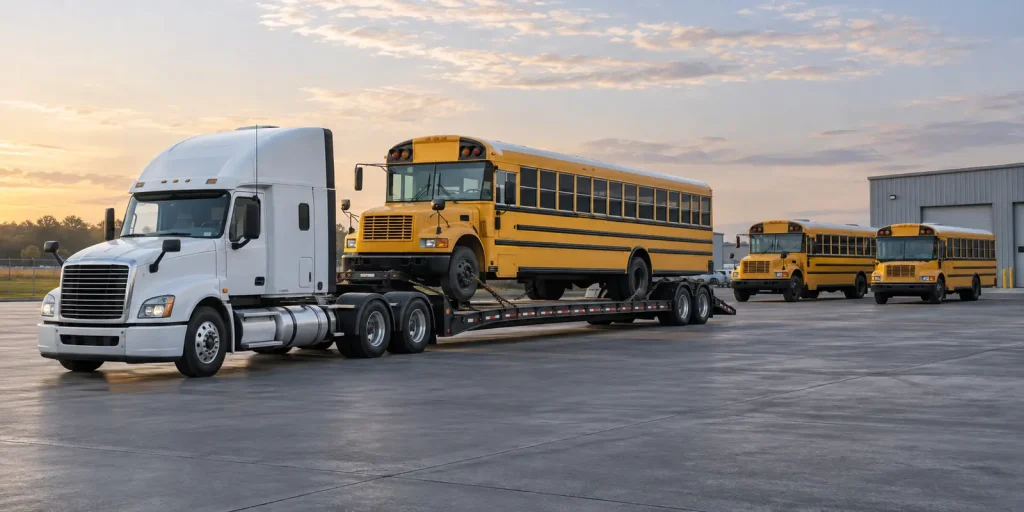
Lowboy, removable-gooseneck, and other low-profile trailer configurations may be evaluated for full-size buses because loaded height is a central planning factor. Trailer transport also keeps highway mileage off the bus and may be appropriate for non-running units, uncertain mechanical condition, refurbishment moves, and customers that do not want the vehicle driven long distance.
Step-deck transport
A step deck may be suitable for certain smaller Type A or medium-size buses when the complete loaded profile fits the equipment and route. Exact dimensions—not the bus category alone—determine whether this option works.
Driveaway service
A roadworthy bus may be considered for qualified driveaway service when the customer accepts added mileage and operating hours. Mechanical condition, tires, brakes, registration, insurance, fuel type, route, weather, and operating requirements all need review. A bus being able to start in a yard does not by itself establish that it is suitable for a long-distance driveaway move.
For a broader comparison of the variables that influence pricing, see the commercial bus transport cost guide.
Loading, Yard Access, and Special Equipment
Bus length and wheelbase create wide turning requirements. Low front clearance, long rear overhang, and deployed accessories can also affect the loading angle. Before dispatch, the site contact should confirm:
- The loading area is firm, level, and clear of low branches or overhead obstructions
- The gate and internal roads can accommodate a highway tractor and long trailer
- Parked buses or employee vehicles will not block trailer alignment
- Keys and operating instructions are available
- Air-brake, battery-disconnect, wheelchair-lift, or alternative-fuel procedures are disclosed
- Winching or other loading assistance is identified before the truck arrives
For brand-specific planning examples, the Blue Bird school bus transportation guide explains why model, chassis, configuration, and installed equipment must be verified without assuming every bus from one manufacturer ships the same way.
How Multi-Bus Pickup and Delivery Are Sequenced
- Validate the manifest. Confirm each VIN, location, condition, dimension set, and release contact.
- Group compatible units. Organize buses by route, size, readiness, and likely transport method.
- Resolve exceptions. Separate units with missing keys, uncertain brakes, dead batteries, tire problems, or pending paperwork.
- Set pickup waves. Coordinate truck arrivals with dealer or district yard capacity.
- Confirm receiving capacity. Match delivery timing to the destination’s staff and available space.
- Track by unit. Use VIN or fleet number in status reporting so every bus remains identifiable through the move.
One central project contact on the customer side reduces conflicting instructions. Elevation Transport Services can coordinate the transportation plan and communication flow, while the dealer, district, or buyer remains responsible for vehicle information, release authority, site access, and disclosed operating condition.
What Determines a Commercial School Bus Quote?
School bus quotes are built from the actual shipment details. The principal factors include the dimensions and weight of each unit, operating condition, origin and destination, transport method, carrier positioning, route, loaded height, permit requirements when applicable, site access, scheduling flexibility, and total number of buses.
Multi-unit volume does not automatically create a fixed per-bus discount. Savings may be possible when units are ready together, routes align, and pickup and delivery windows allow efficient equipment planning. Scattered origins, non-running units, narrow appointment windows, or mixed bus sizes may require separate equipment and schedules.
School Bus Dealer and District Transport FAQs
How far ahead should a multi-bus move be planned?
Begin as soon as the unit list, locations, and expected release window are known. More lead time gives the project team room to verify dimensions, identify non-running units, group compatible buses, and coordinate yard access. An urgent move may still be possible, but equipment and scheduling options can be more limited.
Can running and non-running buses move under one fleet plan?
Yes. The manifest should clearly separate roadworthy, loadable, and non-running units. Each exception needs details about steering, braking, tires, keys, air systems, access, and available loading support so the correct equipment can be considered.
Can one quote cover buses from several locations?
Yes. Provide a location-by-location unit list with condition, dimensions, contacts, hours, and destinations. The project can then be evaluated by route group and pickup wave instead of forcing the customer to request unrelated quotes for every bus.
Does every full-size school bus require the same trailer?
No. Body style, length, height, weight, wheelbase, ground clearance, overhang, installed equipment, condition, loading access, and route all affect trailer selection. Final equipment should be assigned from verified shipment details.
Request a School Bus Fleet Transport Quote
For one bus, send the year, chassis and body information, dimensions, condition, photos, pickup, delivery, and timing. For a dealer inventory move or district fleet project, send a spreadsheet with one row per unit so the transportation plan can be organized by VIN, location, equipment need, and pickup wave.
Request a nationwide school bus or commercial fleet transport quote from Elevation Transport Services. We coordinate transportation for dealers, school districts, contractors, municipalities, and commercial fleet owners based on the requirements of the actual vehicles and sites involved.