
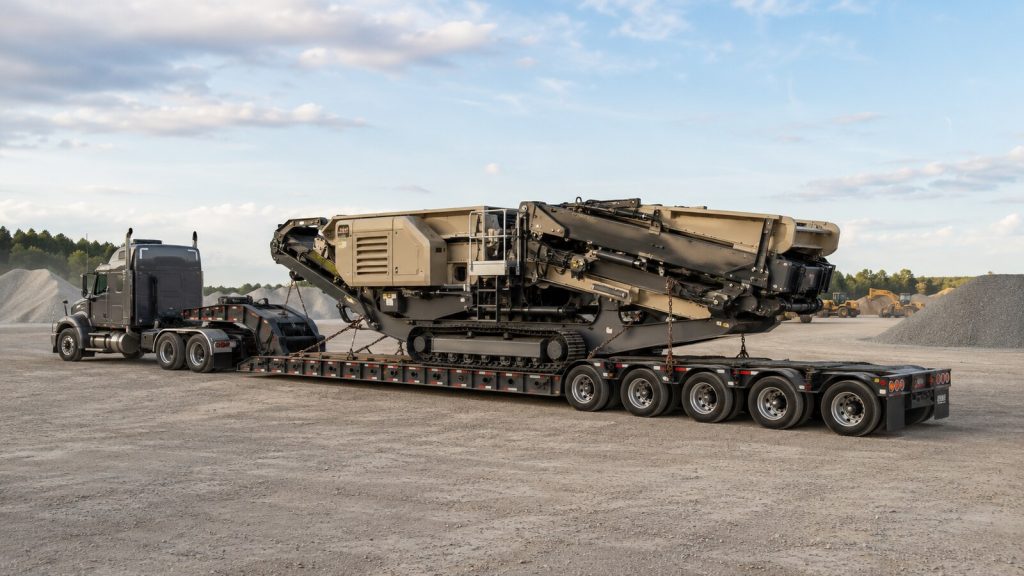
Mobile crushers and screening plants are built to move around quarries, demolition sites, recycling yards, and road projects, but highway transport requires a carefully matched trailer and confirmed transport configuration. Tracks, folding conveyors, hoppers, screen boxes, platforms, guards, and power units can make these machines longer, taller, wider, and heavier than the basic equipment description suggests.
Elevation Transport Services coordinates nationwide crusher and screening plant transport for equipment dealers, auction buyers, contractors, aggregate producers, recycling operators, and rental fleets. We focus on compact and mid-size tracked or wheeled plants that can move efficiently on an RGN, lowboy, double-drop, or suitable step-deck configuration. Larger machines are evaluated individually so extreme superload work does not become the default plan.
Crusher and Screening Plant Transport at a Glance
| Planning item | Typical consideration |
|---|---|
| Equipment | Tracked jaw, impact, and cone crushers; scalping, inclined, and horizontal screens; compact stacking equipment |
| Likely trailer | RGN or lowboy for most tracked plants; double-drop or multi-axle configurations when profile or weight requires |
| Loading | Self-loading when the machine safely tracks and the carrier approves; assisted loading for non-running equipment |
| Critical measurements | Transport-mode length, width, height, weight, ground clearance, and track dimensions |
| Permit planning | Based on the complete loaded combination, route, axle weights, and state requirements |
Why Transport-Mode Specifications Matter
Crushing and screening equipment has separate working and transport configurations. A conveyor that is extended at a quarry may fold alongside or over the machine for travel. Hoppers, handrails, platforms, screen boxes, and discharge belts may also change position. The quote must be based on the machine as it will actually sit on the trailer.
Manufacturer specifications show the range. Powerscreen lists its compact Metrotrak jaw crusher at approximately 40 feet 8 inches long, 7 feet 10 inches wide, and 10 feet 6 inches high in transport configuration. Its larger Premiertrak 450 is listed at roughly 52 feet 10 inches long, 9 feet 2 inches wide, and 11 feet 2 inches high. Metso lists the Lokotrack LT300GP mobile cone crusher at approximately 95,000 pounds with transport dimensions around 56 feet 9 inches long, 11 feet 5 inches wide, and 12 feet 5 inches high.
Those examples are not substitutes for the serial-number-specific manual or data plate. Options, return conveyors, magnets, extended hopper walls, dust-suppression equipment, guards, generators, and wear components can change the shipping profile.
Equipment Covered by This Service
Tracked jaw crushers
Jaw plants are commonly used for primary crushing. Their feeder, hopper, crushing chamber, tracks, and discharge conveyor create a long, concentrated load that often favors low-deck equipment.
Impact and cone crushers
Impact crushers and cone crushers may include recirculating screens, return conveyors, magnets, and additional platforms. Confirm whether those components fold with the machine or must be removed and transported separately.
Mobile screening plants
Scalping, inclined, and horizontal screens can have wide working footprints but narrower transport profiles after conveyors, hopper extensions, and walkways are folded. Transport width and height should be verified after the plant is fully prepared.
Compact stackers and related units
Tracked stackers and smaller conveying units may fit a step deck or other configuration when dimensions, weight, loading method, and deck capacity allow. Larger conveyors or dismantled plant components require separate evaluation.
Selecting the Right Trailer
RGN trailer
An RGN is often the first option considered for a tracked crusher or screen. The front of the trailer detaches and lowers, allowing an operating machine to track onto the deck. The carrier must evaluate ramp angle, track loading, concentrated weight, ground clearance, and the surface available at pickup and delivery.
Lowboy trailer
A lowboy helps control loaded height and supports heavier equipment configurations. Loading may require a detachable neck, ramps, a dock, or other assistance depending on the trailer and machine.
Double-drop or step-deck trailer
A double-drop may help with certain tall components or machines, while a step deck may work for compact support equipment that remains within the trailer’s capacity and dimensional limits. These are shipment-specific choices, not automatic substitutes for an RGN.
Multi-axle equipment
Heavier plants may require additional axles to distribute weight. Deck capacity alone is not enough; the complete tractor-trailer axle configuration must work for the equipment, route, and permit conditions.
See our RGN, lowboy, and step-deck comparison for a broader explanation of trailer characteristics.
How to Prepare a Mobile Crusher or Screen for Pickup
Confirm the manufacturer’s transport configuration
Fold and lock conveyors, hoppers, platforms, handrails, catwalks, and other moving assemblies according to the manufacturer’s procedure. Photograph the completed transport configuration from every side before dispatch.
Remove loose material
Clear aggregate, demolition debris, metal, soil, and other material from the hopper, feeder, belts, screen decks, tracks, and undercarriage. Residue can add weight, conceal damage, or fall during highway transport.
Secure or remove loose accessories
Remote controls, tools, belt scrapers, hoses, spray bars, guards, maintenance platforms, and spare parts should be secured in approved locations or shipped separately. Personal property and loose site materials should not be placed inside the machine for transport.
Check tracks and machine condition
Confirm whether the plant starts, tracks, steers, and stops as designed. Disclose hydraulic leaks, damaged tracks, weak batteries, low fuel, flat tires on wheeled units, disabled controls, or fault codes before a carrier is assigned.
Plan loading space
The site needs firm, level space for the tractor-trailer to enter, stage, detach or position the trailer, load, reconnect, and leave. Identify soft quarry roads, steep grades, overhead conveyors, utility lines, low tree limbs, narrow gates, wash racks, and restricted operating hours.
Information Needed for an Accurate Quote
- Manufacturer, model, year, and serial number when available
- Exact transport-mode length, width, height, and weight
- Machine type and installed options
- Photographs in both operating and folded transport configurations
- Whether the unit starts, tracks, steers, and stops
- Track width, ground clearance, and known loading restrictions
- Pickup and delivery addresses and site contacts
- Site hours, appointments, PPE or induction requirements
- Available loading or unloading assistance
- Preferred pickup window and any deadline-related constraints
If components will be removed, provide a separate list with the dimensions and weight of each item. Do not assume every conveyor, screen, magnet, or hopper section can share the main trailer.
Crusher and Screening Plant Transport Cost Factors
Pricing depends on the specific machine and route. Important variables include:
- Transport dimensions and weight: These determine trailer availability and whether oversize or overweight permits may apply.
- Trailer and axle configuration: A compact plant that fits a common RGN setup generally has more carrier options than a wider, taller, or heavier multi-axle load.
- Distance and legal route: Mileage matters, but route restrictions, bridges, construction zones, urban access, and state permit conditions also affect planning.
- Operating condition: A machine that safely tracks onto the trailer is different from a non-running plant requiring a winch, tow unit, crane, or other loading assistance.
- Disassembly: Removing conveyors, magnets, or hopper components may reduce dimensions but can create additional cargo, labor, and loading requirements.
- Site access: Quarries and recycling yards may require extra staging time or specialized site coordination.
- Timing and availability: Advance notice, season, fuel costs, and suitable carrier availability can influence the quote.
For related equipment-shipping considerations, review our heavy equipment transport cost guide.
Permit Complexity and Route Planning
Compact plants may produce relatively straightforward moves, while larger crushers and screens can exceed ordinary width, height, length, or weight limits. Permit complexity is therefore usually low to moderate for the service profile we target, but exact shipment information is required.
Permit decisions are based on the complete loaded vehicle. Trailer deck height must be added to the machine’s transport height, and tractor-trailer axle weights must be calculated. Each state controls its own oversize and overweight permit process and may impose routes, travel hours, lighting, signage, or other conditions. The FHWA permit overview explains this state-administered framework.
No permit or escort requirement should be promised before the machine, trailer, route, and applicable state rules are verified.
Securement and Condition Records
The carrier determines the final securement plan using the machine’s approved tie-down points, appropriate chains or other devices, working-load limits, blocking, and trailer configuration. Federal requirements addressing heavy vehicles, equipment, and machinery appear in 49 CFR 393.130.
Document the machine before loading. Photograph panels, conveyors, platforms, tracks, guards, controls, and existing damage. Pickup and delivery condition should be recorded on the bill of lading or condition report.
Crusher and Screening Plant Transport FAQs
Can a tracked crusher load itself onto an RGN?
Often, if it safely starts, tracks, steers, and stops and the carrier approves the process. Ground conditions, ramp angle, track loading, clearance, and available space must be confirmed.
Must conveyors be removed?
Not always. Many machines have folding transport configurations. Removal depends on the model, installed options, final dimensions, carrier plan, and manufacturer’s procedures.
Can a non-running screening plant be moved?
Potentially, but its exact condition and loading needs must be known in advance. Tell the coordinator whether it rolls or tracks freely, whether brakes release, and what winching, lifting, or towing assistance is available.
Do mobile crushers require permits?
Some do. Requirements depend on the loaded length, width, height, axle weights, trailer, route, and states traveled. A machine cannot be classified accurately from its name alone.
Can a crusher and screen move on the same trailer?
Only when the combined dimensions, weight, deck space, weight distribution, and securement plan support it. Many plants require separate trailers.
What is the fastest way to receive an accurate quote?
Send the manufacturer, exact model, verified transport specifications, clear photos, operating condition, origin, destination, and site-access information. A data sheet or equipment manual is particularly helpful.
Request a Crusher or Screening Plant Transport Quote
Elevation Transport Services coordinates transport for compact and mid-size mobile crushers, screening plants, and related aggregate equipment. Provide the exact transport configuration, weight, dimensions, condition, photos, route, and preferred pickup window so the trailer and loading requirements can be evaluated correctly.
Request a specialized equipment transport quote for a mobile crusher, screening plant, or related quarry machine.


