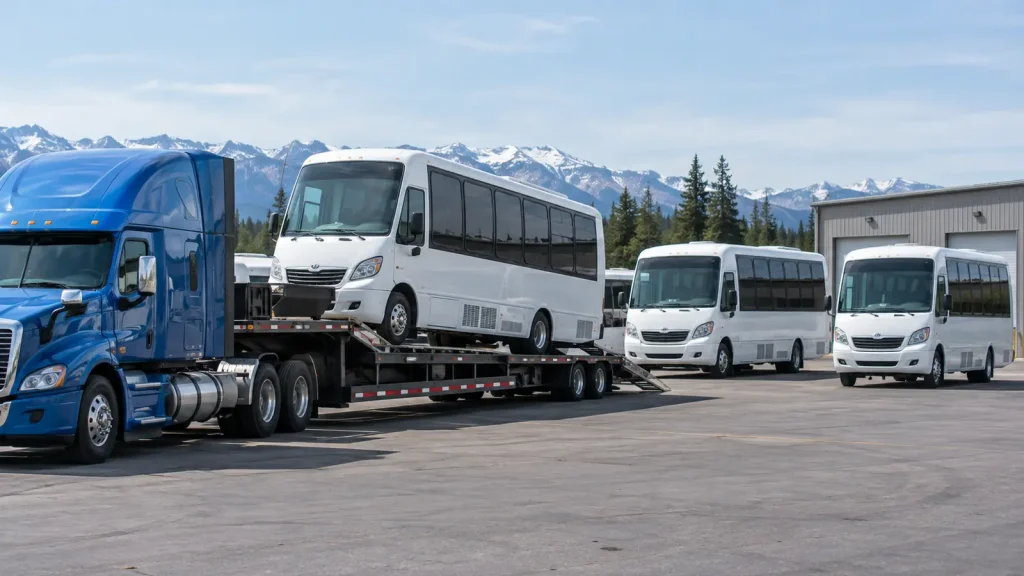
Shuttle bus fleet transport should be planned around service continuity, unit condition and facility access – not treated as several unrelated vehicle shipments. Hotels, airport transportation operators and senior-living communities often depend on their shuttles every day, so a workable plan identifies which units can leave service, which require trailer transport and how arrivals will be staged before the first vehicle moves.
Elevation Transport Services coordinates nationwide shuttle bus transport for commercial operators, fleet owners, dealers and institutional buyers. This guide focuses on the operational decisions that matter when several shuttle buses are being purchased, replaced, transferred or relocated.
Why Shuttle Fleet Moves Need Their Own Plan
A single shuttle can often be reviewed from its specifications, condition and route. A fleet move adds dependencies. One unit may be roadworthy, another may have a lift issue, and a third may be waiting for release paperwork. The receiving facility may also have room for only a few arrivals at a time.
The plan should therefore answer three questions before dispatch:
- Which vehicles are genuinely ready for release?
- Which transport method fits each shuttle’s dimensions and operating condition?
- How many units can the destination receive without disrupting service or blocking the property?
For projects that include buses, vans and other commercial vehicles, our Multi-Vehicle Fleet Transport service explains how mixed fleets can be coordinated under one unit list.
Different Operators Have Different Priorities
Hotels and resorts
Hospitality fleets may move during a property opening, management change, vehicle replacement or transfer between locations. Guest transportation normally must continue while vehicles are exchanged. The operator should identify the minimum number of shuttles that must remain available and schedule the rest in workable pickup waves.
Hotel shuttle buses may also have luggage racks, running boards, roof equipment, wraps or property-specific accessories. These features should be documented because they can affect overall dimensions, loading clearance or preparation.
Airport and parking operators
Airport-area shuttle fleets often operate on repeating routes with limited downtime. A fleet change may involve moving replacement vehicles into a market while outgoing units are returned, sold or transferred elsewhere. Separate the inbound and outbound lists so stock numbers, destinations and release contacts are not mixed.
Pickup and delivery should be planned around the operator’s actual yard, not the passenger loading area. Confirm gate access, trailer turning space, appointment requirements and whether the site can stage transport equipment without interfering with active shuttle lanes.
Senior-living communities
Senior-living shuttles may include wheelchair lifts, mobility-equipment storage, low-entry steps, handrails and other accessibility features. Record these items accurately and disclose any lift, suspension, brake or electrical issue that affects the vehicle’s operation or loading.
The receiving community should designate a staff contact who understands the unit list and can confirm where each shuttle will be parked. Deliveries should be separated from resident loading areas whenever the available property layout permits.
Build One Reliable Unit List
A commercial fleet move needs one current control document. Avoid relying on several email threads or sales listings that may show different information. Give each shuttle one row containing:
- VIN, stock number or fleet number
- Year, manufacturer, model and body type
- Actual length, width, height and approximate weight when available
- Passenger configuration and accessibility equipment
- Running or non-running condition
- Whether it starts, drives, steers and brakes normally
- Current origin and final destination
- Release contact, receiving contact and facility hours
- Keys, paperwork and title or release status when applicable
- Known damage, tire issues, warning lights or mechanical concerns
Photos should be labeled by VIN or fleet number. Include all sides of the vehicle, the roofline, front and rear overhang, lower-body clearance and any disclosed damage. A clean unit list lets Elevation Transport Services review the fleet as a whole while still assigning the correct plan to each shuttle.
Decide Between Driveaway and Trailer Transport
A roadworthy shuttle may be considered for driveaway when its registration, insurance, mechanical condition and customer requirements support that method. Driveaway avoids adding trailer deck height, but it adds mileage and operating time. A vehicle that moves around a parking lot is not automatically ready for a long interstate route.
Trailer transport may be appropriate for non-running units, new inventory, vehicles of uncertain roadworthiness or shuttles that should not accumulate highway mileage. Trailer selection depends on the actual vehicle dimensions, weight, ground clearance, overhang and route. Cutaway buses, high-roof passenger vans and larger shuttle bodies should not all be assumed to fit the same equipment.
For a broader explanation of rate variables, see the Shuttle Bus Transport Cost and Trailer Guide. A shipment-specific quote should be based on the real units and locations rather than a generic per-mile figure.
Document Modifications and Accessibility Equipment
Commercial shuttle bodies are frequently equipped differently from the base chassis. These additions can change clearance, operability or securement planning. Identify features such as:
- Wheelchair lifts and exterior lift doors
- Kneeling systems or modified suspension
- Retractable steps and low body skirting
- Roof-mounted HVAC equipment, cameras or antennas
- Rear or interior luggage racks
- Extended mirrors and aftermarket bumpers
- Destination signs, wraps or removable exterior panels
Close and secure access doors, luggage compartments, windows and loose interior items before pickup. Do not remove accessibility equipment merely to simplify the description; document the shuttle as it will actually be transported.
Plan for Non-Running Shuttle Buses
“Non-running” describes only one part of the condition. The carrier also needs to know whether the shuttle rolls, steers and brakes; whether the transmission can be placed in neutral; whether the parking brake releases; whether all tires are inflated; and whether keys are available.
A vehicle with locked wheels, disabled steering or damaged suspension may require outside loading assistance beyond a standard trailer winch. Disclosing that condition before dispatch protects the schedule and prevents equipment from arriving with an unusable loading plan.
If several units are non-running, list the condition of each one separately. Do not apply a general note to the entire fleet unless the condition has actually been verified across every vehicle.
Review Pickup and Delivery Access
Hotels, parking facilities and residential communities can have covered entrances, tight circulation lanes, landscaped islands and limited truck staging. The transport pickup should occur in an area that can accommodate the assigned equipment safely.
Before confirming the appointment, review:
- Gate width and access instructions
- Overhead canopies, signs, wires and tree limbs
- Turning and backing space
- Surface condition and slope
- Rules for commercial trucks or after-hours access
- Space to position the shuttle for loading
- A delivery staging area away from active passenger operations
When a property’s normal passenger entrance will not work, establish a nearby commercial loading location with the operator before dispatch. Do not leave that decision for the driver to solve on arrival.
Use Pickup Waves to Protect Daily Operations
Fleet replacements rarely need every shuttle to move at the same moment. Pickup waves can keep transportation service available while creating a predictable flow for the receiving location.
A practical sequence might prioritize released and road-ready units first, place non-running vehicles in a separate equipment group, and hold mission-critical shuttles until replacements have arrived. The exact sequence depends on carrier capacity, route, customer timing and site access; it should not be represented as a guaranteed schedule.
One designated fleet contact should approve changes to the unit list and receive shipment updates. That reduces conflicting instructions from separate properties or departments.
What Determines the Quote?
The main quote inputs are unit count, exact vehicle profile, condition, route, transport method, origin and destination access, release readiness and requested timing. Multiple origins, restricted appointments, non-running units and unusual loading needs can change the equipment and coordination required.
The most useful first submission includes the complete unit list and photographs. Sending only a total quantity forces important differences between the shuttles to be discovered later.
Shuttle Bus Fleet Transport FAQ
Can running and non-running shuttles move in the same project?
Yes, but each condition must be documented individually. Different units may require different transport equipment or loading assistance.
Can replacement shuttles arrive before the outgoing fleet leaves?
Inbound and outbound waves can be coordinated when both facilities have enough staging space and the unit lists clearly separate the two groups.
Do wheelchair lifts change the transport plan?
They can. Lift doors, low steps, suspension condition and related equipment should be included in the photos and measurements so loading clearance can be reviewed.
How should a hotel or airport operator request a fleet quote?
Provide the VIN or fleet number, dimensions, condition, photos, origin, destination, release contact and requested timing for every shuttle. Include any property-access restrictions and the preferred arrival sequence.
Request a Commercial Shuttle Fleet Quote
Elevation Transport Services coordinates nationwide shuttle bus and commercial fleet transportation around the actual vehicles, operating requirements and facilities involved. Send the full unit list so the project can be reviewed as one commercial move.
Request a shuttle bus fleet transport quote from Elevation Transport Services.