Motorcoach dealer and operator fleet transport works best when the shipment is planned as a documented commercial handoff, not simply as a vehicle pickup. The dealer must release the correct coach, the transport method must match its dimensions and condition, and the receiving operator needs a workable arrival sequence. Those decisions matter whether one sold coach is moving to a new owner or several units are entering service at different facilities.
Elevation Transport Services coordinates nationwide motorcoach moves for commercial bus dealers, charter and tour operators, fleet owners and qualified buyers. This guide focuses on the dealer-to-operator workflow: what information controls the move, where preventable delays occur, and how to prepare a coach for a clean pickup and delivery. For general service information, visit our Motorcoach Transport page.
Start With the Business Handoff, Not the Truck
Trailer selection matters, but it should not be the first unanswered question. A motorcoach transaction usually involves several parties: sales staff, a dealer release contact, the transportation coordinator, the carrier, a receiving fleet manager and sometimes a maintenance or refurbishment facility. A clear handoff map keeps the coach, paperwork and destination aligned.
Before dispatch, identify:
- The coach VIN, stock number and fleet number, if applicable
- The party authorized to release the unit
- Any balance, title or documentation hold that could prevent release
- Pickup hours, appointment rules and lot-access instructions
- The receiving location and person authorized to accept delivery
- Whether the coach is entering service, storage, inspection or refurbishment
- The required arrival order when more than one unit is moving
This is more than administrative detail. A carrier can arrive with suitable equipment and still lose a pickup window if the stock number is wrong, keys are unavailable or the release has not been approved.
Dealer Delivery and Operator Relocation Are Different Moves
Dealer sold-unit delivery
A dealer delivery begins with inventory control. The exact coach must be matched to the buyer’s paperwork, condition report and release authorization. If the unit has been sitting, the dealer should confirm its current mechanical condition rather than rely on an older listing. Battery condition, air-system operation, tire condition and warning indicators can change while a coach is stored.
Dealer staff should also disclose aftermarket equipment, roof-mounted components, loose parts inside baggage compartments and any body or suspension issue that affects loading. When the unit came from an auction or third-party yard, our Bus Dealer and Auction Transport page explains the additional release and access details that commonly need attention.
Operator fleet intake or repositioning
An operator move is controlled by continuity. The question is not only when a coach can be picked up; it is when the receiving yard has room, staff and a plan for inspection. A coach arriving during a dispatch peak or at a facility with no staging space can disrupt daily operations.
For multiple coaches, separate the transportation plan from the service schedule. Identify which units can leave first, which must remain available and where incoming coaches will be parked before inspection or assignment. Large mixed-bus projects may be better managed through a broader multi-vehicle fleet transport plan.
Build a Coach Record That Can Be Used at Dispatch
A dealer listing or sales sheet is a useful starting point, but dispatch needs a current transport record. Each coach should have one set of information that follows it from quote through delivery.
- Identity: year, manufacturer, model, VIN, stock number and current location
- Physical profile: actual overall length, width, height, approximate weight, wheelbase, ground clearance and highest fixed point
- Operating condition: whether it starts, drives, steers, brakes, builds air pressure and raises or lowers as expected
- Exterior details: mirrors, roof equipment, low body panels, overhangs and known damage
- Access details: gate instructions, lot surface, turning space, loading area and pickup hours
- Handoff details: release contact, keys, required documents, receiving contact and delivery restrictions
Photos should show all four sides, the roofline, front and rear overhang, lower body clearance and any disclosed damage. If measurements are estimates, label them as estimates and arrange for verification before equipment is committed.
Choose Driveaway or Trailer Transport From the Actual Coach
A roadworthy coach may be considered for driveaway when its registration, insurance, mechanical condition and customer requirements allow it. Driveaway avoids adding trailer deck height, but it also adds mileage and operating hours. The coach must be safe and ready for the route, not merely capable of moving around a dealer lot.
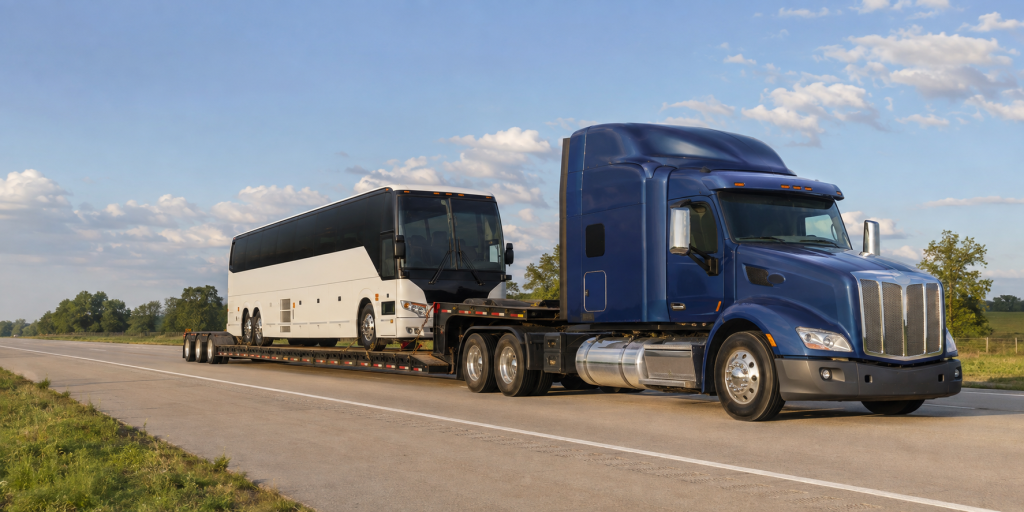
Trailer transport may be preferred for non-running units, new or high-value inventory, coaches with uncertain roadworthiness, refurbishment moves or transactions where the buyer does not want highway mileage added. Low-profile equipment may be evaluated because total loaded height, usable deck length and loading geometry can all be limiting factors.
No trailer type should be promised from the model name alone. Long wheelbases, low front valances, rear overhang, air-suspension condition and rooftop equipment all affect the loading plan. Our Commercial Bus Transport Cost guide explains how equipment, condition, routing and timing influence a shipment-specific rate without relying on unsupported flat pricing.
Plan the Pickup Site Before the Carrier Arrives
Motorcoach dealers and operator yards are not automatically trailer-friendly. Parked inventory, narrow gates, employee vehicles and fixed curbs can remove the space needed to align a long trailer. A good pickup plan answers practical questions in advance:
- Can the assigned equipment enter, turn and exit without backing into public traffic?
- Is there a firm, reasonably level area for loading?
- Are overhead wires, tree limbs, signs or canopies near the loading path?
- Can the coach be moved from its parking row to the loading area?
- Will another vehicle block the gate during the appointment?
- Who can make an on-site decision if the planned position is unavailable?
Dealers should avoid surrounding a sold coach with fresh inventory after a pickup is scheduled. Operators receiving several units should reserve a staging area and mark where each coach belongs.
Prepare Running and Non-Running Coaches Differently
Running coaches
Confirm that the coach starts consistently, builds the air pressure needed to release the brakes, steers normally and can move to the loading area. Secure baggage doors, access panels and loose interior items. Provide keys and written instructions for any battery disconnect, kneeling feature or suspension control that is not obvious.
Non-running or uncertain-condition coaches
“Non-running” is not a complete loading description. State whether the coach rolls, steers and brakes; whether the parking or air brakes can be released; whether tires are inflated; and whether the suspension is raised, lowered or inactive. Also identify any available loading assistance.
A coach with locked wheels or disabled steering may require outside lifting or recovery equipment beyond a trailer winch. That condition must be known before dispatch so the carrier does not arrive with an unusable plan.
Control Multi-Coach Moves by Exception
When several motorcoaches are involved, create one master unit list and then highlight the exceptions. Most units may share the same route and access plan, while one coach has a flat tire, one is stored at another lot and one must arrive first for inspection. Those differences should be visible, not buried in email threads.
Useful controls include:
- A single version of the unit list with VINs and current status
- Pickup waves based on release readiness, not just unit number
- A designated contact at every origin and destination
- Separate notes for non-running units and unusual dimensions
- Condition photos tied to each VIN or fleet number
- An arrival sequence the receiving yard can actually accommodate
- Immediate reporting when a unit is unavailable or its condition differs from the record
This approach gives the dealer and operator one clear view of the move while allowing each coach to receive the equipment and handling its condition requires.
What Determines a Commercial Motorcoach Quote?
A useful quote is based on the complete shipment, not a generic per-mile number. The main inputs are the coach dimensions and weight, operating condition, transport method, origin and destination access, route, number of units and requested pickup window. Remote yards, restrictive appointments, uncertain dimensions and special loading assistance can change the plan.
For dealer and operator moves, release readiness is also a cost-control issue. When the coach, keys and paperwork are ready during the agreed window, the carrier can focus on loading. When a unit is still on hold or inaccessible, waiting time and rescheduling risk increase.
Motorcoach Dealer and Operator Transport FAQ
Can a dealer arrange transport directly to the buyer’s fleet yard?
Yes. The shipment can be coordinated from the selling dealer to the buyer’s commercial location when the release contact, coach record, pickup access and receiving instructions are confirmed.
Should a motorcoach be driven or transported on a trailer?
The right method depends on the coach’s roadworthiness, dimensions, value, customer requirements, route and acceptable mileage. A qualified driveaway option may fit some road-ready coaches, while trailer transport may fit non-running, uncertain-condition or mileage-sensitive units.
What information is needed for a non-running coach?
Report whether it rolls, steers and brakes; whether the brakes can be released; tire and suspension condition; available keys; and any loading assistance at both locations. Photos and actual dimensions are also needed.
Can several coaches be delivered in a specific order?
Arrival sequencing can be planned around unit readiness, transport capacity and facility access. The receiving operator should identify priority units and realistic staging capacity before dispatch.
Request a Motorcoach Dealer or Fleet Quote
Send the VIN or stock number, coach dimensions, operating condition, photos, pickup release contact, destination contact and requested timing for every unit. Elevation Transport Services will review the shipment and coordinate an appropriate transport plan around the actual coaches and locations.
Request a commercial motorcoach and fleet transport quote from Elevation Transport Services.